

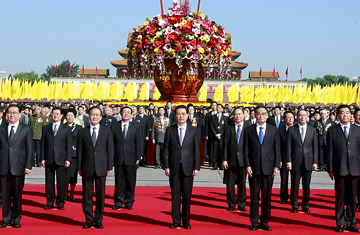
Heir apparent Xi Jinping, seen here with China's other top leaders at a National Day celebration, is poised to take the reins in November
(6 of 6)
The recent political chaos--which included Xi's unexplained public absence for two weeks in September as well as a Ferrari crash that killed the son of a top Hu ally--will only heighten the Communist Party's desire for control. Bo's presumed political patron, security chief Zhou Yongkang, who is primarily responsible for having built up the massive weiwen apparatus over the past decade, must retire next month because he will soon turn 70. His replacement may not be promoted to the Standing Committee, which has spurred speculation that the security state might be reined in. But there's little chance of that, say those who study the weiwen system. "Xi and the new Standing Committee will want to make weiwen decisions themselves instead of having one person [like Zhou] control it," says China's Security State author Guo. "The new leaders' No. 1 criterion for success will still be maintaining stability."
That repressive instinct was on full display on Oct. 1 when China's leaders gathered in Tiananmen Square to commemorate the birth of the People's Republic. To the outside world, Tiananmen evokes a foiled democratic uprising crushed by an authoritarian regime. To the Chinese people, Tiananmen, which means Gate of Heavenly Peace, is the soul of the nation and the refuge of last resort. Last month, a Chinese court sentenced seven people to hard labor in a prison camp. Their crime? Protesting the illegal demolition of their homes or businesses by kneeling briefly in front of the Chinese flag in Tiananmen Square. It was an act of desperation, just one of hundreds of thousands of mass incidents that Xi Jinping will have to face in his coming decade in power. How Xi and his fellow leaders handle that growing dissent will help decide the future of China--and the rest of the world as well.