

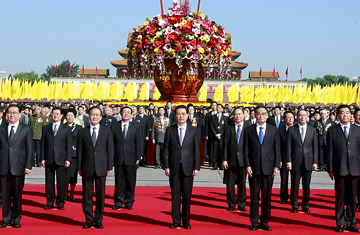
Heir apparent Xi Jinping, seen here with China's other top leaders at a National Day celebration, is poised to take the reins in November
(5 of 6)
Whatever his politics prove to be, Xi will be assuming a position of diminished authority. (Along with the most important title of General Secretary of the Communist Party, Xi will eventually inherit two other top posts: Chairman of the Central Military Commission and President of China, the latter being the least vital of his roles.) Each of the People's Republic's four previous leaders has enjoyed less power than his predecessor. Decisionmaking in today's China is not concentrated in the hands of one man, as in the days of Mao, when policy was made decisively but often impulsively. To rein in such runaway power, major courses of action nowadays depend on a consensus reached by the members of the Politburo Standing Committee. Most of its current nine members (the ones at Tiananmen Square during the Oct. 1 celebrations) will retire when the 18th Party Congress convenes on Nov. 8, and there are rumors that the governing body will be trimmed to seven seats for efficiency's sake.
Horse trading over who will ascend to the Standing Committee's vaunted ranks has preoccupied the party for years, pitting current leaders like Hu against party elders like Jiang Zemin, the former President who was the one to anoint Xi in the first place. No one outside the inner party sanctum knows for certain which men (and possibly one woman) will rule China until the new Standing Committee struts across a stage during the Party Congress. But beyond Xi and Li Keqiang, its members will most likely include Zhang Dejiang, a hard-liner who studied economics in North Korea, and Li Yuanchao, a political reformer who underwent midcareer training at Harvard.
Far more than articulating a vision for China's future, Xi's job will be to bring these disparate Standing Committee members together, especially at a time when the party is still reeling from a scandal earlier this year that downed Bo Xilai, its most individualistic and charismatic politician. A leftist princeling, Bo has been accused of a slew of crimes, ranging from chronic abuse of power to violating party discipline. In August, his wife was handed a suspended death sentence in the murder last year of a British business consultant. Beyond the lurid headlines, the case tore open the narrative of a seamless political transition and exposed rifts in a Chinese leadership that yearns to portray itself as united. Bo's most shocking transgression may have been to use an unchecked security apparatus to spy on his political rivals, possibly even wiretapping top leaders. The fallout from Bo's case appears to have distracted the leadership with byzantine power plays at a time when the country's slowing economy needs a firm guiding hand.