

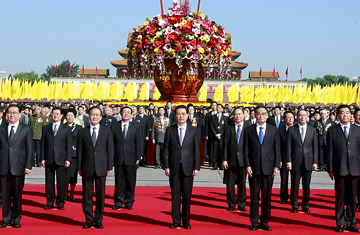
Heir apparent Xi Jinping, seen here with China's other top leaders at a National Day celebration, is poised to take the reins in November
On Oct. 1, the 63rd anniversary of the founding of the People's Republic of China, nine black-haired men in dark suits stood solemnly in Beijing's Tiananmen Square. Looming over the clutch of men who constitute China's current and future leadership were dozens of security cameras affixed to lampposts. Goose-stepping soldiers marched past. As always, a giant portrait of Chairman Mao Zedong, the founder of the People's Republic, gazed over the square, as did hundreds of plainclothes police with their telltale buzz cuts and watchful eyes. Despite the lavish floral displays and representatives of ethnic minorities in colorful garb, the square bristled with the paraphernalia of a paranoid security state.
China is on guard, even more so these days as the ruling Communist Party prepares for a once-in-a-decade leadership handover. On Nov. 8, the nation's rulers, led by the grim-faced President and Communist Party General Secretary Hu Jintao, are expected to begin giving way to a new generation led by Vice President Xi Jinping. Heir apparent Xi and the presumed next Premier, Li Keqiang, took part in the Oct. 1 National Day celebrations, their pomaded hair and choreographed steps broadcast in an endless loop on state television.
The nation with the world's second largest economy is on the cusp of a rare political transition, yet the path that its future rulers wish to take is largely a mystery. Though much of the world's attention is focused on the Nov. 6 U.S. presidential election, what will start to transpire in China two days later is perhaps more important. The fate of the global economy hangs in part on how China's leaders navigate potentially perilous financial and political shoals.
Xi and his cohort rose to the top of the Communist Party hierarchy, however, because of their ability to conform to a slow-moving and inherently conservative ruling consensus. A decade ago, China watchers armed with equally scant information about the next crop of Chinese commanders predicted that the Hu era would usher in political reforms to match China's economic liberalizations. Those hopes were dashed. "No one imagined that Hu Jintao's administration would be so backward," says Zhang Yihe, the daughter of a purged communist revolutionary and a popular writer in Beijing whose books are banned in China. "Instead of liberalizing, political controls have actually increased. It's an absurd situation for this day and age."
Hard Times