

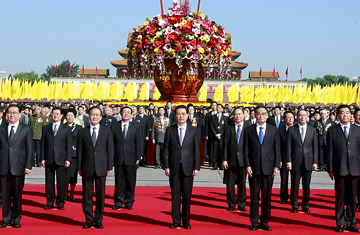
Heir apparent Xi Jinping, seen here with China's other top leaders at a National Day celebration, is poised to take the reins in November
(3 of 6)
There is little indication that Xi and company will loosen the grip of this repressive regime, although they may reorganize the channels of decisionmaking. "The top priority for the Chinese Communist Party is to hold on to its own power, and to do that the party knows that society must be stable," says Xie Yue, a politics professor at Shanghai's Tongji University. But in a country light on rule of law, that leaves 1.3 billion Chinese vulnerable to the whims of their leaders. Local cadres know their promotions depend on avoiding unrest, and the easy course is to crack down on any incipient dissent instead of addressing the underlying social problems. "For the sake of stability," Beijing sociologist Yu Jianrong wrote last year, "[we have] suppressed the livelihood of the people, suppressed human rights, suppressed rule of law, suppressed reform. But stability preservation has not suppressed corruption, nor has it suppressed mining tragedies, nor has it suppressed illegal property demolitions and seizures."
The Chinese Communist Party has overseen the greatest economic expansion in world history. It has helped lift hundreds of millions of people out of poverty. Without tying itself in ideological knots, the party embraced a state-sponsored capitalism that is fundamentally opposed to the socialist underpinnings of the People's Republic. A new covenant was struck in what technically is still a communist state: the government will allow you to become rich, but you must not question the leaders' political wisdom. It seemed an acceptable pact. After all, isn't the freedom of a few--the dissidents, the independents, the democrats--worth sacrificing for the overall good of the most populous nation on the planet? Yet as we have learned from modern history, in the longer term, an authoritarian society tends toward less stability the more prosperity its people enjoy.
Now, particularly as China's economy slows and double-digit growth can no longer propel the nation, its citizens are clamoring for yet another break from the past. Talking over the past couple of months with Chinese of varying backgrounds--academics, entrepreneurs, farmers and even the odd Communist Party diehard--I have been struck most by their shared conviction that China's political system must fundamentally transform itself or face the kind of social upheaval that swept away the imperial dynasties and ancient warring kingdoms. While many Westerners are buying into the hype of a coming Chinese century, the Chinese I spoke to predicted an altogether more complicated future. In these uncertain times, no wonder the Chinese leadership is striving for weiwen, even if the whole endeavor reeks of desperation. "Rule of law, political transparency--that's probably a long way away," admits Fang Ning, director of the institute of political science at the Chinese Academy of Social Sciences, a government-funded think tank. "But we all know that change will eventually have to come to China."
Mystery Man