

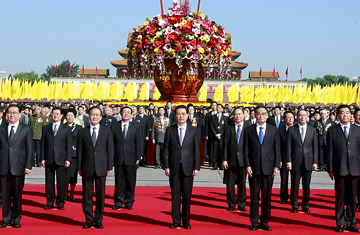
Heir apparent Xi Jinping, seen here with China's other top leaders at a National Day celebration, is poised to take the reins in November
(2 of 6)
Today, China is a much richer country than it was in 2002, but it is not a particularly freer place. As incomes have risen, so has the disparity between rich and poor. Corruption has proliferated. At the same time, the Internet has given once blinkered citizens alternative sources of information to the censored state media--and an alternative way to register their displeasure. The number of protests and other so-called mass incidents has increased so dramatically that embarrassed Chinese authorities stopped publishing figures seven years ago. Unable to depend on the courts to deliver justice, Chinese citizens are taking to the streets to demand action, despite the threat of imprisonment for such daring. The most common complaints include land grabs by property developers in cahoots with corrupt local officials, the flouting of pollution regulations by factories, unsafe working conditions for migrant laborers and government restrictions on ethnic minorities like Tibetans and Uighurs in the country's far west. The most recent estimate, by a Beijing sociologist, was of 180,000 protest-related incidents in 2010, compared with 87,000 five years before. Prominent Chinese academics tell me that the number today is probably double that of two years ago.
No one is suggesting that these numerous but isolated flare-ups will spread into a wildfire of dissent--at least, not yet. But the rising discontent spooks China's stability-obsessed leaders, not least because the Arab Spring demonstrated how quickly revolutions can gather force. "If you look at these protests, almost all of them are because of abuse of governmental power," says outspoken Chinese economist Mao Yushi. "That's why the leaders are very worried. They are the cause of the political instability."
Yet as it marks more than six decades in power, the Communist Party still refuses to undertake significant political reform. Instead, Hu and his henchmen have constructed a massive internal-security apparatus that by China's admission received more than $110 billion in funding this year. Weiwen (pronounced Way-when) is Chinese shorthand for maintaining stability, and it is the government's mantra these days, encompassing everything from security forces who beat up protesting grannies to secret prisons that house political dissidents to the armies of censors who scrub the media and Internet of wayward opinions.
For local officials and government ministries, promising to improve weiwen is the easiest way to wrest cash from the central government. Much of the funding is off the books, disappearing into a black hole of armed agents with no clear bosses and jails that officially don't exist. Also competing for its share of China's security budget is the military, which has amplified its saber rattling--against the U.S., Japan and other Asian nations--to earn more influence with the new leadership. "There is no question that China is the biggest security state in the world," says Guo Xuezhi, a professor at Guilford College in North Carolina whose most recent book is called, straightforwardly, China's Security State.