

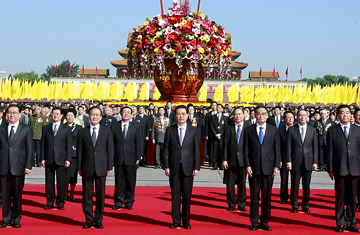
Heir apparent Xi Jinping, seen here with China's other top leaders at a National Day celebration, is poised to take the reins in November
(4 of 6)
The figure expected to hold China together is Xi (full name pronounced She Jean-ping), a 59-year-old member of the red aristocracy whose father Xi Zhongxun was a trusted lieutenant of Mao's before he was purged in the early 1960s and later jailed. The younger Xi then traded the lacquered halls of Beijing's leadership compound for seven years of labor in an agricultural commune. Like other members of a generation displaced by the Cultural Revolution--Mao's terror-filled 1966--76 political campaign, which upended hundreds of millions of lives--Xi may have developed an allergy to tumultuous times. All the more reason, then, to value weiwen. When colleges reopened in the mid-1970s, Xi studied chemical engineering at Beijing's Tsinghua University, a breeding ground for future party leaders. His government career has limned the ideological shifts of the Communist Party: he first served as a personal assistant to a Defense Minister, then toiled as a village apparatchik and later as a provincial and municipal chief, riding a wave of foreign investment washing over the country's prosperous coast.
As Xi climbed the ranks, his pedigree and ability to reach out to feuding factions within the party served him well. His expeditious rise mirrors that of other so-called princelings, whose privileged upbringings as Communist Party scions contrasts with the more hardscrabble backgrounds of the government's other main faction, made up of Communist Youth League members like Hu.
Beyond the bare bones of his rsum, little is known about the next President. Xi's father eventually resurrected his career in the late 1970s and helped liberalize China's economy while also calling for political openness. In 1989, the elder Xi even condemned the bloody crackdown on the Tiananmen Square protesters. His son, however, has not openly expressed any taste for reform. His current job requires him to receive world leaders and build the party's morale and scope. Xi's public persona, such as it is, hews to the hale and hearty, a reflection of little more than his broad shoulders, ample grin and strong handshake. Some of his personality consists of deflected glory: his second wife is a mascara-loving folksinger in the People's Liberation Army--quite a contrast to the retiring spouses of other recent Chinese leaders.
While discussing China's performance during the global financial crisis in a speech in Mexico City in 2009, Xi showed a darker side in a rare strident public moment. "Some foreigners with full bellies and nothing better to do engage in finger-pointing at us," he seethed. "First, China does not export revolution. Second, it does not export famine and poverty. And third, it does not mess around with you. So what else is there to say?" Still, academics with government ties have told me that Xi has met quietly in recent months with reform-minded intellectuals, including some who have called for the government to face up to the Tiananmen crackdown. He is far more widely traveled than Hu, and his sister, first wife and only child all live abroad. (His daughter is studying at Harvard under an assumed name.)
First Among Equals