

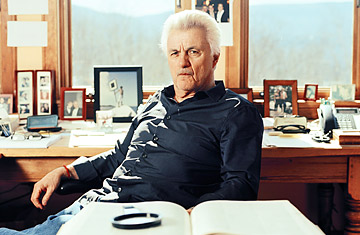
Bear country. Irving at his desk in Vermont. He splits his time between New England and Toronto.
(6 of 7)
Many writers try to avoid partisan fiction, believing that art should raise questions instead of answer them, but what distinguishes Irving is a consistent zeroing in on the toughest issues--abortion, religion, sexuality, AIDS--that both define and divide America at various times. He does it with unbounded generosity toward his characters, not just the heroes but also the villains. And he does it almost exclusively through fiction. He's not in the op-ed pages, nor is he writing book reviews or magazine pieces. He's old-fashioned in that light--critical to the literary landscape but also apart from it.
The walls of Irving's apartment are crowded with black-and-white portraits--of Gnter Grass, Kurt Vonnegut, friends and mentors--and a charcoal profile of his son Everett. In his office hangs a poster for the film adaptation of The Cider House Rules orbited by shots from the set. But the dominant decoration, hanging over his desk, is a giant cluttered tackboard busy with family photos, some new, some faded and curled at the edges. He fingers one, an image of him wrestling his boys in the backyard, and says, "That was a long time ago."
Though I hate to bring it up--because it implies the grave, because Irving is fit enough and sharp enough to write for another 20 years--there is the unavoidable question of legacy.
Of course Irving could guess how critics or friends would respond to this question. Edmund White, for example, says, "I think John's distinctive place in the American literary landscape is as a Dickensian fabulist who has invented many great plots and tableaux and who will be remembered primarily as a humorist and as someone who tackled taboo subjects."
But when Irving finally speaks, it is with no such definitive language. He hasn't written his last sentence. He rolls his shoulders, not with a shrug but a stretch, as if we are once again facing each other in the gym. "You have to know as a writer the difference between how you consider yourself publicly and the way you must continue to only consider yourself a lowly practitioner," he says. "Every new page you start, you are a beginner. And I am writing every day to challenge myself, to make myself better and stronger."
His mouth hikes up, and his voice takes on an amused, challenging tone. "You never see a great wrestler who doesn't drill, who stops fanatically practicing his best shot. My old coach used to say that if you were in it for the match, if you were in it for the trophies, you were in it for the wrong reasons." He pauses for a long time, hinging together two thoughts as if with one of his trademark semicolons. "If you presume to love something, you must love the process of it much more than you love the finished product."
This is his way of saying that legacy does not concern him so much, that his life as a writer has been about the drills, the practice, the lovely drudgery of putting one word in front of another and building characters and worlds that may speak of their time but will also, with the help of faithful readers, be lasting.
But then his gaze skips over to his bookshelves, weighed down by hardcover and foreign editions of his novels, as if to account for more than 40 years of dreams, the many worlds and lives stored in one person.