

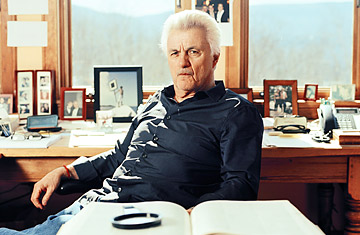
Bear country. Irving at his desk in Vermont. He splits his time between New England and Toronto.
(3 of 7)
Irving is famous for his endings; he always conceives his final sentences before he begins a book. Two transgender women are the heroes of this novel, and in the final passage, one of them, Miss Frost, says to Billy, "My dear boy, don't put a label on me--don't make me a category, before you get to know me!"
Irving says that making too big a deal over Everett's connection to a novel about sexual tolerance or failing to see this novel's obvious relationship to several of his earlier novels--and his process as a novelist, one who always builds a story from the end to the beginning--would be to miss the point.
But, he says, the timing of this book does feel urgent, not only because of Everett but also "because of the resurgence of gay bashing and a homophobic backlash against gay marriage in the U.S. at this very time."
After two hours of racking weights, jogging the treadmill and grappling on the mats, Irving and I hit the steam room. He massages a kink from his neck, then holds out a hand and flexes his fingers. "This is my most important instrument," he says.
He writes all of his first drafts in longhand, and if his fingers ever cubed and stiffened with arthritis, he doesn't know what he would do. So he takes precautions, sticks to the smaller barbells now. Less weight, more reps.
The same rules apply to his fiction. "I am writing shorter and shorter novels," he says. "My commitment to this is no different than my exercise routine or my decision to give up drinking beer. I am aware of the limitations of aging. And there is nothing more important to the novelist than the preservation of memory. My grasp of fictional detail and chronological story is worsening, so I must work with what I have to make sure I'm fully cognizant of what I'm creating."
Until I Find You runs 824 pages, Last Night in Twisted River clocks in at 554, and In One Person is by comparison a scant 427. Irving's next novel, which he began Christmas Eve, will be even shorter--and, he predicts, the next novel shorter still.
In One Person might be brief by Irving's standards, but it has his characteristic sweep. The story moves from Vermont to Vienna to New York and encompasses the repressive '50s, the exuberant '60s, the promiscuous '70s. The chronology does not move in a straight line but flashes forward and back. This generates suspense--you witness the outcome and wonder how it came to pass--but it also makes time as restless as gender.
We see that Miss Frost, the small-town librarian who in the novel's opening scene recommends that Billy read Great Expectations, setting him on the path to becoming a writer, was once Big Al the wrestler; we see that Uncle Harry the lumberman ends up wearing his dead wife's clothes around the nursing home. There are drag prostitutes and sexy macho wrestlers. White says Irving shows us men and women "in all their clangorous, multihued variety. Just as he breaks down the walls of place and time in the dissolving bath of memory, so he breaks down all gender distinctions."