

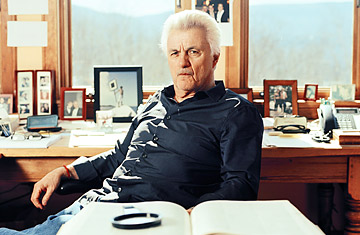
Bear country. Irving at his desk in Vermont. He splits his time between New England and Toronto.
(4 of 7)
Irving pulls on a watchman's cap, zips into a blue down jacket. The wind that blows constantly off Lake Ontario wobbles a stop sign as if it were a red balloon. Reflections of pedestrians ripple along the windows of boutique shops and coffeehouses. This is the midtown Toronto neighborhood Irving calls home.
He walks with his head down, staring hard at the sidewalk as if reading something there, the cracks in the concrete like the messy cursive that fills his many notebooks. He points out the Champion Tae Kwon Do studio where he used to spar regularly, the sensei there an Iranian immigrant, a misfit who came here with nothing and made a great life for himself. "There are so many Canadians like that," he says.
Readers strongly associate Irving with New England, the setting of much of his fiction and the place where he grew up. (He attended Phillips Exeter Academy, where his stepfather Colin F. Irving taught history.) But he says he doesn't feel grounded there. He splits his time between Toronto and Vermont but finds these days a stronger connection to Canada for its political liberalism, its acceptance of cultural and sexual diversity. "I'm sure you've heard a lot of Americans of a certain liberal persuasion talking about moving to Canada," he says. "With me, it's not all talk. I'm proud to be an American--but remain frustrated by how backwards and misinformed we obstinately remain."
We stop by Irving's apartment to pick up his wife Janet Turnbull, a literary agent with a bright laugh and hair that moves from red to chestnut, depending on the light. She runs her own agency and represents Irving, but when they first met she was working as an editor for his Canadian publisher. Irving gave a reading, and at a meal following the event, he couldn't stop talking with Turnbull, so enchanted by her that he neglected everyone else at the table.
Tonight we eat at Pastis, owned by Georges Gurnon, the same restaurateur who oversaw their dinner that night so long ago. He greets us at the door, and when he takes Irving's hands in his, he turns to me and says, "He is a very famous writer but also a very humble man." The tables are draped in white linen, the walls a roughly textured stucco painted canary yellow. A picture of Robertson Davies, the Canadian author who read at Irving's wedding, hangs forbiddingly in a shadowy staircase. But before we find our table in back, we sneak into the kitchen.
This is where Irving did much of his research for the restaurant scenes in Last Night in Twisted River. When we push through the swinging door, we are met with a blast of heat and a flurry of surprised smiles as the cooks jokingly tell Irving to throw on an apron and get to work.
Research has always been an essential part of Irving's writing process, and he tells me now to study the cooks, to watch their flashing knives and flaming pans, as he did for so many hours with his notebook in his lap. "What I like especially is how they move around each other, the choreography of the kitchen," he says.