

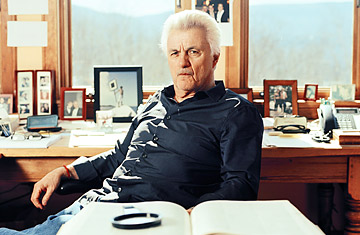
Bear country. Irving at his desk in Vermont. He splits his time between New England and Toronto.
(5 of 7)
We are joined at our table by several friends, among them Marty Schwartz, a doctor who serves as a medical consultant for all of Irving's novels. In The Fourth Hand, he introduced the idea of formication, the imagined feeling of insects crawling all over one's skin. In Until I Find You, he helped Irving figure out how a woman might die while having heroic, athletic sex. In Last Night in Twisted River, he told Irving to dose up a character on aspirin so that he might die of blood loss from a severed hand. And in In One Person, he helped principally with the sections concerning AIDS symptoms and treatment.
The novel begins in an era when the worst thing that could happen to you after sex was an STD or pregnancy; it propels Billy through the onset of HIV, the fear and panic and bewildering lack of information about it. Toward the end of the novel, Billy joins the New York Athletic Club and bloodies his nose when sparring with a wrestling partner. The horrified response of the other men, who race away from him as if the mere sight of his blood could cause infection, is the quintessential example of Irving's melding the personal and the political, a character's story intertwining with the community's.
Irving tends to talk in the same careful, premeditated manner in which he writes. Typically, when I pose a question, he leans back and knits his fingers together on top of his head. His jaw flexes as if he is tasting his words before he shares them. When he finally speaks, he does so slowly, with many asides and pregnant pauses.
The exception to this: politics. When our discussion of In One Person bridges into the coming U.S. election, he brings his hand down in a karate chop that shakes the table and rattles the ice in my glass.
"When I wrote The World According to Garp in the 1970s, I thought the furor over birth control was over, I thought the abortion debate could potentially settle down following Roe v. Wade, and I thought I would never again feel the need to write about sexual tolerance. Just as I never thought I'd see the country as divided as it was during 'Nam." He tightens his mouth. "I was too hopeful. Here we are again. Here I am again."
His most iconic characters never left. Glenn Close played Jenny Fields in the 1982 film adaptation of Garp. It was her first feature, and she considers the role definitive in her career. "Every part I've played since then, I suppose you can say, Jenny gave birth to. I'm almost always, at one extreme or another, a sexual suspect." She mentions her recent film Albert Nobbs, in which she plays a woman who poses as a man. "There are so many people out there who fall through the cracks, so many people out there who are hiding in order to survive." Empathetic narratives about them are necessary, revolutionary.