

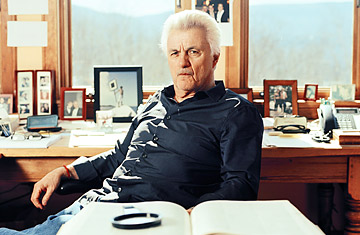
Bear country. Irving at his desk in Vermont. He splits his time between New England and Toronto.
(2 of 7)
All of which make 2012 a year of reckoning. And quite possibly the year of his return.
These past few years--with the release of The Fourth Hand, Until I Find You and Last Night in Twisted River especially--his sales have dropped, and some reviewers have accused him of writing baggy, protracted plots. In One Person should silence them.
Irving is known for his sensitive treatment of sexual outsiders. Dr. Larch, the saintly abortionist in The Cider House Rules, has sex only once in his life. The same goes for Jenny Fields, the heroine of The World According to Garp, who strips off her nurse's uniform and lowers herself onto a terminally wounded invalid not for pleasure or companionship but because she wishes to have a child on her own. The narrator of A Prayer for Owen Meany is referred to as "a non-practicing homosexual," and indeed, he seems to love Owen, even if he will never come out of the closet and say so.
Billy Abbott--the narrator, main character and, to use the term Irving invented for Jenny Fields, "sexual suspect" of In One Person--likes men and women. In Vermont in the 1950s, Billy says his bisexuality "meant that I would be categorized as more unreliable than usual by straight women, while at the same time (and for the same reason) I would never be entirely trusted by gay men." There is some poetic justice to this. Irving's good friend the author and critic Edmund White says, "He's always been bi-curious as a storyteller. Rounding up all his misfits in his novels who prove to be sympathetic and compelling characters could populate a Key West bar."
It's true that In One Person, with its many gay and transgender characters, is not a departure for Irving; his familiar touches are everywhere--in the settings (New England, Vienna), the wrestling (Billy learns the duck under for self-defense), the absent father, the protagonist who becomes a writer, the delirious treatment of humor and pathos. But it is also a daring novel, politically charged, infused with tenderness and forgiveness and love--between parents and children, between lovers, between friends.
Life is so hard for sexual outsiders, Irving says, and it makes him love them all the more. Which is what he told his youngest son Everett when Everett revealed he was gay: "I love you all the more."
On this matter, Irving wishes to be very careful and clear. He began taking notes on the novel in 2002, long before he even knew Everett was gay. He did not write In One Person because he has a beloved gay son, and the novel is not about having a gay son.
Readers have a tendency to want to find the truth in fiction, to interpret the characters as veiled versions of the writer. "Billy Abbott's experiences are not based on my experiences or my son's," Irving says. But he acknowledges that the fiction might potentially be helpful in imparting some truths. "Probably, because Everett is my son, I must have felt more urgency about making In One Person my next novel--about writing it sooner rather than later, about wanting Everett to read it while he was still in his late teens or early 20s."