

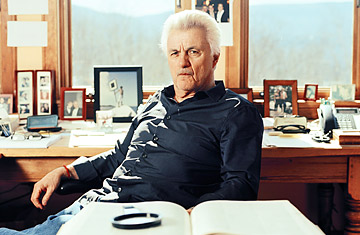
Bear country. Irving at his desk in Vermont. He splits his time between New England and Toronto.
He slaps the side of my head--twice, in quick succession--then hooks a hand behind my neck, and we lean hard into each other, our weight stuttering us one way, then the other. "Keep your elbows in," he says, his breath hot on my face. "Nothing's going to stop me from tearing into you except those elbows." He bullies his chest forward, and I block him with an elbow. "Good."
In a gym in midtown Toronto in February, I am wrestling John Irving. We are surrounded by treadmills, barbells, medicine balls. The floors are padded and the walls mirrored, our reflections grappling all around us hundreds of times over. Irving is 69 at this point, and though his hair has silvered and his mouth is creased by lines that look like parentheses, he works out several hours every day, a self-proclaimed gym rat who moves like someone half his age, square-shouldered, thin-waisted.
He seizes my arm and twists it painfully inward so that my shoulder feels as if it may snap from its socket. I force my elbow up, which is exactly what he wants me to do, darting into the hole I make for him, dragging me down, slamming my body to the mat.
He whispers tenderly in my ear, "That's called a duck under."
My shoulder is paralyzed and my face flames with rug burn, but when Irving scrambles upright, holds out a hand, hoists me to my feet and says, "Let's try that again," I do as he says, because it's not every day that you get flung to the mat by one of the greatest writers of our time.
It is impossible to imagine the American--or international--literary landscape without John Irving. As his friend the novelist and physician Abraham Verghese says, "I can't think of anyone else who has endured in quite the same way: adored by a loyal and ever growing readership because he is capable of producing novels in steady succession, each of which becomes part of our cultural heritage."
In 1968, at the age of 26, Irving published his first novel, Setting Free the Bears. He is the author of 12 more, including The World According to Garp, The Cider House Rules, A Prayer for Owen Meany and A Widow for One Year. He has a trophy case of honors: a National Book Award (for Garp), an Oscar for Best Adapted Screenplay (for Cider House), his 1992 induction into the National Wrestling Hall of Fame. He has sold tens of millions of copies of his books, books that have earned descriptions like epic and extraordinary and controversial and sexually brave. And yet, unlike so many writers in the contemporary canon, he manages to write books that are both critically acclaimed and beloved for their sheer readability. He is as close as one gets to a contemporary Dickens in the scope of his celebrity and the level of his achievement; the two of us couldn't walk down the street or order a coffee in Toronto without his being hyperventilatingly recognized by a fan.
That success aside, there comes a point in anyone's life--whether they have spent their career as a mechanic, a postal worker, a banker, a writer--when they begin to account for a lifetime of work, its worth and impact. For Irving, that moment is now. He turned 70 in March. He and his wife are celebrating their 25th anniversary. Three decades have passed since he appeared on the cover of this magazine. And he has a new novel, In One Person, out May 8.