

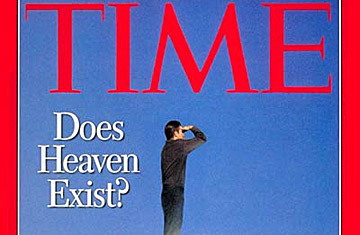
March 24, 1997 TIME Cover: Does Heaven Exist?
(6 of 6)
The Rev. Richard McBrien feels that we have quite enough heaven now, thank you. McBrien, a liberal Catholic theologian at the University of Notre Dame who has skirmished on occasion with the Vatican but whose theological and historical grasp few would question, believes that before the Vatican II reforms of the mid-1960s, his church had slipped into the lazy role of using heaven and hell as "stories meant to encourage and frighten." Catholicism's once vivid otherworldliness had devolved into a sort of rote board game, in which preoccupation with involved scenarios of the life to come became an excuse to measure out one's life in Hail Marys and First Fridays while ignoring real moral concerns. Not only did this baroque stasis "go beyond the knowledge provided in Scripture: 'Eye hath not seen nor ear heard,'" McBrien maintains, but it also essentially "forfeited the game to the critical scientific mind that dismisses it as unbelievable." What some describe as today's apathy or scanting of heaven, he calls health. It allows Catholics "to focus on our life in this world and our responsibility to one another now, and let God take care of the rest." Do they believe in heaven? "Of course they do, and at no point more vividly than when burying a loved one. At a funeral Mass, they have a vivid sense that somehow they will be reunited someday, or that somehow they are at peace or in a better place. And that's when the best of the tradition comes out."
The University of Chicago's Marty agrees that heaven has lost none of its potency in what he sees as its primary assignment, as the proof of Romans 8: 35 — Nothing shall separate us from the love of Christ. "You turn over to God how that will be expressed in unimagined realms," he says. "We can negotiate everything about the paving, the mapping and the furniture of heaven. I don't know of a church, even a conservative one, where I could get run out for saying the language about pearly gates and golden streets is symbolic. But the love of God after death is nonnegotiable. I would get run out of all churches if I were to say physical dust is the end, mere dust, annihilation."
Amen to that. David Burton, however, has managed to find a church that is not waiting for a funeral service to talk to him about that which touches his soul. When he moved to Nashville five years ago, he found Fathers William Fleming and Patrick Kibby of the Cathedral of the Incarnation. Burton says they were not only willing to state in their homilies that heaven is the appropriate reward for a life of faith and work. They were, in fact, "always reminding us that this life is not all there is. We're being called to something much greater. That it is the ultimate goal for all of us."
That was all Burton needed to hear. There is a cheerful babble today as his Catholic ritual class, having completed an earnest discussion on the intricacies of Lenten observance, joins the rest of the congregation for coffee and doughnuts. A woman comes up to Burton carrying a beautiful, cruller-smeared little girl in her arms and tells a visitor how much help, both spiritual and practical, Burton gave her in adopting a Chinese child. He is embarrassed but obviously pleased. The present and the future both look pretty good. "The important thing," he says, "is I know what I'm living for, and I'm O.K. with that. I'm living for heaven, and that's all right."
—Reported by Richard N. Ostling/Santa Barbara, Elisabeth Kauffman/Nashville, Victoria Rainert/New York, Greg Burke/Rome and S.C. Gwynne/Austin