

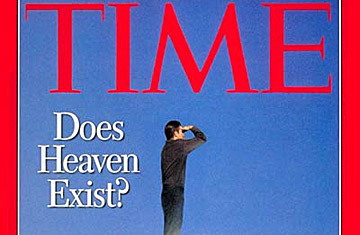
March 24, 1997 TIME Cover: Does Heaven Exist?
(2 of 6)
When heaven comes up in public debate these days, it is often just as metaphor for the concerns of a perfectible secular kingdom of man, as in the debate that started in the Washington Post last month and continued online in Slate over Jesus' statement that "it is easier for a camel to go through the eye of a needle than for a rich man to enter the kingdom of God." Peter Wehner, policy director for Jack Kemp's think tank, Empower America, decried the worldliness of Christians who feel they can serve both God and Mammon — resulting in too many people left in poverty. The Rev. Robert Sirico qualified Christ's admonition as being against only the "unjustly" rich, and accused Wehner of trying to win attention by "bashing rich Christians." As aspersions were cast and tax credits argued, heaven fell to the wayside.
In the '60s, clerics and scholars pondered the question Is God dead? (the subject of a 1966 TIME cover). Asked what is going on now, they first cite denominational differences and the ongoing religious split between modernists and traditionalists. Episcopalians have always been less eager than Baptists to stress the hereafter. Liberal mainline pastors are more reluctant than Evangelicals to review the joys of eternal communion with the living God. Yet with some notable exceptions, the phenomenon seems transdenominational. Martin Marty, the respected University of Chicago religious historian, says, "I can recall from my [Lutheran] childhood many sermons on what used to be called the geography of heaven and the temperature of hell. Now the only time you hear of heaven is when somebody has died." David Wells, a theology professor at Massachusetts' Gordon-Conwell Theological Seminary, notes, "We would expect to hear of it in the Evangelical churches, but I don't hear it at all." He pauses. "I don't think heaven is even a blip on the Christian screen, from one end of the denominational spectrum to the other. The more perplexing question is, What explains this?"
What, indeed? University of California at Santa Barbara professor Jeffrey Burton Russell, author of the upcoming A History of Heaven (Princeton University Press), says, "I think [clerics] want to stay off the subject because they feel they're going to have to climb a wall of popular skepticism." A spokesman for the United Methodist Publishing House is reluctant to comment at all about heaven, explaining that the subject is "controversial." A brother in faith, the Rev. J. Philip Wogaman, whose Foundry Methodist Church is up the street from the White House, explains bluntly, "I'm not interested in speculating on the architecture or the geography. I don't think of heaven as a specified place in the universe to which we could somehow go if we could find the right galaxy. We dig a lot deeper. I preach on trust in God."
Might a robust conception of heaven be the victim of an unbelieving era? Perhaps, but if so, unbelief is selective. Lynn Garrett, religion editor at Publishers Weekly, who has tracked the recent popular vogues for angels and miracles, observes that there is almost no corresponding interest in the place where angels live and from which miracles erupt into our lives. Perhaps the biblical heaven is too big to be marketable. Perhaps it is a victim of its own, centuries-long hype: so much has been claimed for it, much of it contradictory, that our literal-minded age overloads and calls the whole thing a wash. Or perhaps America has finally got heaven just right. Plain. Unvarnished. Stripped of harps and halos. The current generic heaven still delivers when people need it most, say some unsentimental observers — at the death of a loved one. Why bother with it any other time?
Why listen to the song of a mockingbird amid the pear blossoms?
But, as it is written, Eye hath not seen, nor ear heard...the things which God hath prepared for them that love him. —I Corinthians 2: 9
Those who shy away from too much conversation about heaven can point out that detailed description of its charms has hardly been the historical rule. The two ancient peoples who probably contributed most to the heavenly notion both started out imagining a gray, undifferentiated afterlife, called Hades by the Greco-Roman culture and Sheol by the Jews. By 600 B.C., bodily resurrection had been incorporated into Judaism: the book of Ezekiel describes a field of dry bones, which at God's bidding "came together, bone to bone" and lived again. The motif recurred in the later books of the Hebrew Bible, sometimes in combination with a nationalistically tinged Messianism or the re-establishment of a paradise located in a new Jerusalem. In Greece the privileged dead gradually came to inhabit the Isles of the Blessed, later the Elysian fields, and in the 4th century B.C. Plato championed the concept of judgment after death in his Gorgias, and, in Phaedrus, postulated an immortal soul that strove ever upward after gaining its freedom from the flesh. What made Jesus' synthesis of these traditions new was the teaching that heavenly happiness consisted not of material pleasures, tribal triumph or an undifferentiated union with the cosmos, but of a glorious personal transformation in the flesh and an eternal communion with a living God. Far more than a reward, it was the believer's true home, the ultimate human destiny.