

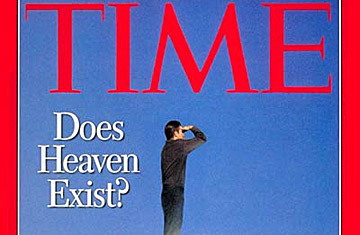
March 24, 1997 TIME Cover: Does Heaven Exist?
(3 of 6)
Jesus was hardly tentative about proclaiming the world to come. His first words as a preacher were, "Repent, for the kingdom of heaven is at hand." However, most of his famous metaphors for heaven (as the treasure hidden in a field or the pearl of great price) address humankind's ideal relationship to God's kingdom more than a specific paradise. Regarding heaven's actual "mysteries," he tells the Apostles that it is not given to most people to know them. An exception to this rule is his chilling parable of Lazarus and Dives: The rich master, consigned to hell, lifts up his eyes to the beggar, who has been "carried by angels into Abraham's bosom," requesting that Lazarus dip a finger in some water to cool him. Impossible, says Abraham, for "between us and you there is a great gulf fixed: so that they which would pass from hence to you cannot; neither can they pass to us, that would come from thence."
Paul, too, seems closed-mouthed. Although he claims to have been "caught up to the third heaven," he is bound to secrecy and offers no travelogue. The first detailed Christian heaven explodes to life in the book of Revelation. Its author, John, is as extravagant as Jesus and Paul are reserved. Here, the One and the Lamb of God occupy a double throne of jasper, fronted by a sea of crystal and framed by a rainbow, attended by 24 elders dressed in white and praised eternally by four winged beasts, who "rest not day and night, saying Holy, holy, holy, Lord Almighty, which was, and is, and is to come." In attendance are angels, "ten thousand times ten thousand, and thousands of thousands."
Did John expect his readers to accept his heavenly portrayal — and his subsequent spectacular descriptions of the Beast, Armageddon, the Last Judgment and Christ's final triumph — as the literal truth? Most scholars today regard his heaven, at least, as symbolic and mystical, its images painstakingly retrieved from the Old Testament and reorganized to frame an allegorical argument rather than an actual detailed reality of the next world. The same applies to hundreds of other heavenly visions generated by various holy men and women in the next two centuries that were eventually excluded from Scripture but some of which nonetheless exerted influence on early Christians.
From those visions and their successors in Christianity's first millennium, a colorful, sometimes contradictory mystical vocabulary of heaven emerged. It was a garden, a city, a kingdom, a temple or, less often, a nut, a womb, a navel. It featured buildings and streets of precious metals and jewels, doves, palm trees (first discerned by the church father Lactantius), singing stones (a late borrowing from Celtic myth), white clothing, milk, honey, wine, olive oil, harps, fountains and ladders. It also developed a set of intractable controversies.
As church fathers such as Irenaeus, Tertullian and Augustine hashed out Christian orthodoxy (and thereby some of the pressing philosophical questions of their day), their investigations inevitably spilled over into the hereafter. A centuries-long battle over the nature of human identity was waged in terms of whether the inhabitants of paradise would consist of body as well as soul. (The orthodox answer, confounding all heresies, remained yes.) If the virtuous soul departed the body at death and had to wait until Christ's Second Coming to reunite with it at the Resurrection, what did it do in the meantime? (A medieval Pope eventually ruled that it lived in heaven in an interim state of blessedness but eagerly anticipated a bodily reunion. That doesn't even address the issue of purgatory.) Exactly where was heaven anyway? The most beautiful explanation had it surrounding the outermost of nine nested spheres, of which earth was the innermost, and composed of a substance that was neither earth, air, fire nor water but rather a marvelous "fifth essence" — or, as the word has come down to us, the "quintessence."
In the 1988 social survey Heaven: A History, Colleen McDannell and Bernard Lang observe that over two millenniums human conceptions of heaven tended to alternate between God-centered visions and more humanist arrangements focused primarily on the reunion and interactions of the sainted dead. Medieval heaven, approached intellectually by the Scholastics or passionately by the mystical school of love, expanded St. Augustine's idea of the Beatific Vision, the saints' rapturous and direct communion with God. The Renaissance Catholic heaven more resembled an ongoing human-to-human celebration presided over by the Virgin Mary. But Protestant reformers of the 1500s reinstated a vision severely centered on Christ and his Last Judgment. This became the dominant understanding in America from its Puritan period through its first century, despite some founding fathers' attraction to the ideas of the Enlightenment.