

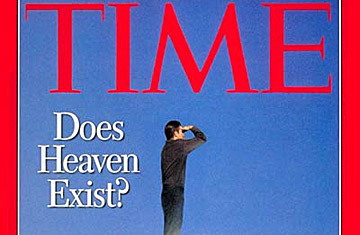
March 24, 1997 TIME Cover: Does Heaven Exist?
(5 of 6)
The book he eventually wrote, A History of Heaven, will be out in May. At minimum, it is the most rigorous modern study of the various strains of Western tradition that culminated in the Paradiso. But its introductory chapter goes beyond that to sketch out an apologia for passionate heavenly belief. In effect, Russell tries to re-establish the honor of the Christian mystical tradition. Scientific method is based on establishing known facts and eliminating contradictions about the material world. Russell points out that those in search of spiritual truth traditionally employed another perspective. To them the material world was at best a distortion, and so rendering it down to indisputable "facts" was of little interest. Instead, they built outward from crabbed reality in a never-ending series of spiritual metaphors, hoping eventually to approximate the all-encompassing divinity they recognized as the actual truth. Russell says he would never hope to convince a nonbeliever of heaven. But "to understand heaven" as Dante and its greatest champions did "is not to narrow down and define but rather to open up to beauty."
And he illustrates. The "space" taken up by heaven is neither the original Eden nor the kingdom of God within us nor a paradise at the end of the world, but all three. The time frame it occupies is not the future or even infinity, but an enveloping eternity in which Christians already participate during the Eucharist. Heaven is "not dull; it is not static; it is not monochrome. It is an endless dynamic of joy in which one is ever more oneself as one was meant to be." Neither a place where the saints commune exclusively with God nor one where they socialize with one another while cold-shouldering their host, it encompasses both communions like "a weaving in which each thread touches every other thread in a spark of loving light." Like Dante's, Russell's paradise is deeply God-oriented and devoid of the cluttered detail that made the Victorian model seem like an ornate mirror of human pride. Heaven, he concludes, "is reality itself; what is not heaven is less real."
Such a vision, expressed so unabashedly by a bona fide member of the academic elite, stands to make a splash in the upmarket reaches of academia, theology and perhaps even among mainline Protestant preachers. In the meantime, however, a fellow revivalist is stirring up more populist waters. Joni Eareckson Tada, a quadriplegic since a diving accident at age 17, is well-known in conservative Protestantism. She appeared on a Billy Graham Crusade, wrote a best-selling autobiography whose royalties she used to found a religious organization to aid the handicapped, and has a radio program airing on 700 stations. Like Russell, she approached heaven in need — in her case, of the bodily resurrection. "I haven't run, I haven't walked, I haven't embraced anybody, so it's good news for me," she says. Previously convinced that heaven "was an esoteric discussion for meditating mystics," she was moved two years ago to write Heaven, Your Real Home. Tada has scant patience for halos and pearly gates ("Boooooring!"). Her alternative is an ebullient pastiche of Scripture, highlighted study questions ("Time out! Have you feared the loss of certain things when you get to heaven? Yes/No") and pungent metaphors, such as this further meditation on the glorification of the human body in heaven: "Compare a hairy peach pit to the tree it becomes, loaded with fragrant blossoms and sweet fruit." Like Russell's, Tada's heaven is firmly God-centered ("Most of all, together we shall fall on our faces at the foot of the throne and worship our Savior forever"). Her musings are scripturally solid, although she points out that even biblical tropes are "only shadowy images of the real thing." Perhaps most important, she is not afraid to sell. "Oh, the things that we shall do!" she writes. "You and your friends will rule the world and judge the angels...Together, we shall receive the morning star and be crowned with life, righteousness and glory." Her book was originally published in 1995 by Zondervan, now a subdivision of HarperCollins. But the Southern Baptist Sunday School Board was so taken with it that it picked it up for educational use, and 50,000 copies are now in print.
"[Heaven is] the secret we cannot hide and cannot tell, though we desire to do both. We cannot tell it because it is a desire for something that has never actually appeared in our experience...We cannot hide it because our experience is constantly suggesting it." —C.S. Lewis