

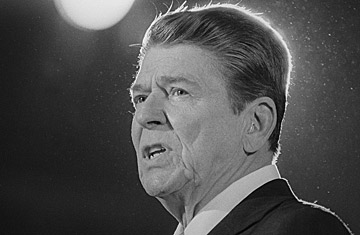
40th President of the United States Ronald Reagan
(6 of 7)
On fiscal issues the Democrats will probably introduce the sort of restrictive trade legislation that Reagan vetoed last year. Even though the trade deficit is declining, many Senate candidates tapped a vein of protectionist sentiment during the campaign this year, and are sure to push for higher tariffs and quotas on foreign manufactured products and textiles.
To make a dent in the burgeoning budget deficit, Congress must confront either the possibility of a tax increase sometime in the next two years or a loosening of the Gramm-Rudman-Hollings noose. This could be the real test of whether the White House and the Democratic Congress will end up seeking compromise or confrontation. Reagan is sure to oppose any outright tax increase, just as he has done in the past. And the Democrats will be as wary as ever of being out front on the issue. But some package of spending cuts and revenue raising seems necessary.
Here Reagan has the upper hand in one sense: he is not seeking re-election, and with a Democratic Senate, he can cast blame more easily than when the Republicans were in control. So he could simply refuse to make any real compromises. But if he does that, his historic legacy will include not only more than doubling the national debt but also leaving office with deficits on the rise. The chance of striking some compromise is enhanced because Reagan will be dealing with two pragmatic and moderate Democrats: Lloyd Bentsen of Texas, the new chairman of the Finance Committee, and Florida's Lawton Chiles, who will be taking over the Budget Committee.
The President will run into more opposition on defense spending. As the new chairman of the Armed Services Committee, Georgia's Nunn will continue to be sympathetic to a strong military while casting a skeptical eye on major ; weapons programs. He will also be more involved in arms-control matters.
The Democrats may challenge the President's stated intention to abrogate the unratified SALT II ceilings on strategic weapons. One way they may try to force a measure of compliance: by tacking requirements onto defense appropriations bills. Future requests for spending on the President's Strategic Defense Initiative will also be subjected to more strings.
Rhode Island's Claiborne Pell, new chairman of the Foreign Relations Committee, will set up more thorough investigations into the Administration's dealings in Central America. These could include probes on the way the CIA is funneling money to the contras and might result in stricter requirements that diplomatic efforts be part of any U.S. policy toward Nicaragua. A Democratic- dominated committee, especially one with members as outspoken as Delaware's Biden, is likely to debate the President's policies far more vigorously than the Republican-controlled panel headed by Richard Lugar.