

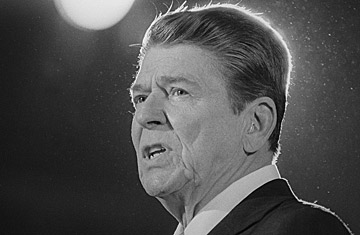
40th President of the United States Ronald Reagan
(5 of 7)
Perhaps the toughest task before the new Senate majority will be speaking in a unified voice. There may be a skirmish for the soul of the party between the Kennedy-Cranston Old Guard and a neoliberal faction led by such Senators as Joe Biden of Delaware and Georgia's Sam Nunn. The Democrats have historically been a party of competing factions. Sometimes, as when Southern segregationists of old were filibustering the civil rights legislation of their Northern colleagues, there has been open warfare. The struggle this time around will be more subdued.
The prospective new majority leader, Robert Byrd of West Virginia, is a master of parliamentary strategy. But even back when Democrats ran the Senate, before 1981, Byrd was not a leader who could mold the party's agenda or articulate it well in front of the cameras. For these reasons he faces a spirited challenge from J. Bennett Johnston of Louisiana, a bright and more telegenic moderate who feels that a majority leader should use his office as a "bully pulpit" for projecting Democratic values to the American people. A secret ballot will be held by the Democratic caucus next week, and although Democratic Senators say Byrd now seems ahead, Johnston pledges to continue his contest.
For the first time in his presidency, Ronald Reagan will be dealing with a Democratic Senate. Will he become more confrontational or more compromising? "The President must go about things in a more conciliatory fashion," says White House Pollster Richard Wirthlin. "His proposals must be made in a focused, targeted way. It will be critical to take a few important goals and to drive them hard." Some observers doubt that the Reaganauts, except perhaps for the President himself, have any great gift for the art of political compromise. Indeed, just about the only aide left in Reagan's inner circle who is adept at handling Congress, Mitch Daniels, may leave the Administration soon. Norman Ornstein, a political scientist at the American Enterprise Institute, says that with the exception of Daniels, "I don't think there's a single individual in the White House with a good understanding of how to work with Capitol Hill."
While most of the President's men are hopeful of molding new congressional coalitions, a vocal minority in the White House will probably urge the President not to give ground to the Democrats. Observes one hard-liner: "Congress, institutionally, is a very timid and frightened place if you force the issue."
For their part, the Democrats are not likely to pick fights right after the 100th Congress convenes in January. They know all too well that if they disagree with Reagan on a key issue, the popular President can take his case to the American people. The Democrats will tread carefully to avoid getting blamed for unpopular revenue increases or budget decisions. "They're in charge," says White House Aide William Ball, "and they're going to have to be accountable." A.E.I.'s Ornstein believes that the new majority has learned some lessons from the past. "The Democrats will not want to be Mondale-ized on taxes," says he. "They will not want to be Carter-ized on foreign policy."