

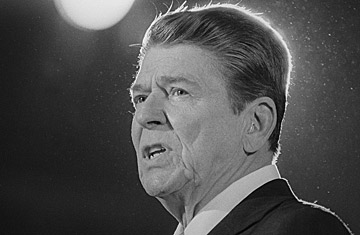
40th President of the United States Ronald Reagan
(2 of 7)
As he addressed White House staff members and reporters in the Old Executive Office Building the day after the election, the President was characteristically putting a there-must-be-a-pony-in-here spin on things. Reagan stressed that Republican candidates in six Senate races had lost by a mere two points or less. "This is not the outcome we sought," he conceded, "but our agenda remains unchanged, and I look forward to its attainment." Presidential aides pointed to the G.O.P. gains in governorships and noted that the Republicans lost far fewer seats (five) in the House of Representatives than the White House party traditionally suffers in a midterm election.
With his ability to shape the public debate, Reagan may not become a lame duck in a traditional sense. Yet for the next two years he will face two houses of Congress that are solidly Democratic and will probably oppose most of his initiatives. "What happened this week creates a minority mentality for the Republicans and a majority mentality for the Democrats," said G.O.P. Political Consultant Ed Rollins, the President's first-term political adviser and '84 campaign manager. "The Democrats will now be more aggressive, and we might be less so."
On election night, the Democrats were already feeling their oats. Party leaders felt that a Democratic dawn was breaking after the long night of Reaganism. In the euphoria, the Democrats were prematurely celebrating their resurgence. "The voters have written a forward to a new book tonight," Democratic National Committee Chairman Paul Kirk told a boisterous crowd at D.N.C. headquarters, "It's called Election '88 -- The Great Democratic Comeback."
Is this the end of an era? By recapturing the Senate, the Democrats feel they have begun to turn the tide of Reaganism, that they have wrested the terms of political debate from the conservatives. Yet the possibility that the Reagan revolution may have run out of steam raised an even more challenging question for the Democrats, a question they have not yet begun to answer: Do they have the right stuff to replace the President's vision with a coherent and compelling one of their own?
Instead of presiding over a basic realignment of partisan loyalties similar to that which occurred under Franklin Roosevelt, one of the most popular Presidents in history will leave office with his party holding eight fewer Senate seats and probably 15 fewer House seats than it did when he came in. Instead of creating a loyal cadre of new Republican voters among blue-collar workers and the young, last week's result demonstrated what analysts call "de-alignment," an overall loosening of all party loyalties.
Indeed, the election produced a startling number of split tickets around the country. In New York, for instance, both Democratic Governor Mario Cuomo and Republican Senator Alfonse D'Amato were re-elected by landslides. In South Carolina, incumbent Democratic Senator Ernest ("Fritz") Hollings crushed his Republican challenger, while Republican Carroll Campbell trounced his Democratic rival for Governor; to make matters even more perplexing, the voters picked a Democratic Lieutenant Governor. In eleven states, voters chose Senators and Governors from different parties.