

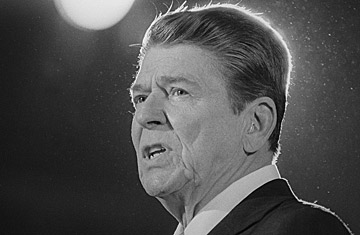
40th President of the United States Ronald Reagan
Ronald Reagan loves to speak of dreamers. Of Founding Fathers who dreamed of creating a free nation, of immigrants who came to America dreaming of a better life. Though he rarely says so explicitly, the President has entertained a grand vision of his own: to transform American politics. In his dream, the "Reagan revolution" that began six years ago would culminate in a massive political realignment, one that would make the Republicans the majority party and pull down the curtain on half a century of liberal government activism.
In pursuit of that goal, the President this fall traveled to 16 states, waging the most vigorous midterm campaign by a President ever in an effort to save the endangered class of Republican Senators he had carried into office in 1980. A vote for these candidates, he said over and over, was a vote to preserve the revolution. The voters, as much as they loved the messenger, seemed unmoved by the message. They trickled to the polls to pick and choose among the local personalities they found appealing. In most of the hotly contested races for control of the Senate, these turned out to be Democrats.
As Sherlock Holmes noted in the curious case of the dog that did not bark in the night, the most important deductions involve things that did not happen. The fact that voters did not make it a referendum on Reagan's record indicated that his personal popularity does not transfer to his policies. The fact that they did not vote along party lines dispelled Republican hopes that certain regions and voting blocs would become part of a fundamental realignment from the Democrats to the G.O.P. The fact that national issues played little role was a sign that while voters may be concerned about such important subjects as Star Wars, U.S. involvement in Nicaragua, the failing farm economy and trade imbalances, there is no political polarization over these issues. In part because the election was not a referendum on Reagan, it turned out to be his most resounding political defeat since he lost the presidential nomination to Gerald Ford in 1976. The Democrats scored a sweeping victory in the Senate, where they replaced a 53-to-47 Republican majority with a 55-to-45 majority of their own. The Teflon President seemed to have Teflon coattails: of the 16 Republican Senators who rode into office on the Reagan wave of 1980, only half were re-elected last week; only four ! Republican Senators won out of the 16 he had campaigned for since Labor Day.
The loss of the Senate was partly mitigated for the Republicans by a gain of eight governorships. Indeed, there was no overall partisan cast to the results. Democratic Senate candidates in the South and West showed surprising strength, but so did Republican gubernatorial candidates in the South. Nevertheless, by losing the Senate, Reagan and the Republicans lost the national political momentum they had been building during the 1980s.