

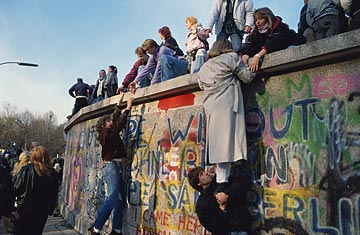
Crowds bear witness to the fall of the Berlin Wall on Nov. 10, 1989
(5 of 7)
"Developments are now unforeseeable," said West German Chancellor Helmut Kohl, who interrupted a six-day official visit to Poland to fly to West Berlin for a celebration. "I have no doubt that unity will eventually be achieved. The wheel of history is turning faster now." At the square in front of the Schoneberg town hall, where John F. Kennedy had proclaimed in 1963 that "Ich bin ein Berliner," West Berlin Mayor Walter Momper declared, "The Germans are the happiest people in the world today." Willy Brandt, who had been mayor when the Wall went up and later, as federal Chancellor, launched a Bonn Ostpolitik that focused on building contacts with the other Germany, proclaimed that "nothing will be the same again. The winds of change blowing through Europe have not avoided East Germany." Kohl, who drew some boos and whistles as well as cheers, repeated his offer to extend major financial and economic aid to East Germany if it carried through on its pledges to permit a free press and free elections. "We are ready to help you rebuild your country," said Kohl. "You are not alone."
Running through the joy in West Germany, however, was a not-so-subtle undertone of anxiety. Suppose the crumbling of the Wall increases rather than reduces the flood of permanent refugees? West Germany's resources are being strained in absorbing, so far this year, the 225,000 immigrants from East Germany, as well as 300,000 other ethnic Germans who have flocked in from the Soviet Union and Poland. According to earlier estimates, up to 1.8 million East Germans, or around 10% of the population, might flee to the West if the borders were opened -- as they were last week all along East Germany's periphery. (Within 48 hours of the opening of the Wall, nearly 2 million East Germans had crossed over to visit the West; at one frontier post, a 30-mile- long line of cars was backed up.) West Germans fear they simply could not handle so enormous a population shift.
Thus West German leaders' advice to their compatriots from the East was an odd amalgam: We love you, and if you come, we will welcome you with open arms -- but really, we wish you would stay home. "Anyone who wants can come," said Mayor Momper, but added, "Please, even with all the understandable joy you must feel being able to come to the West, please do it tomorrow, do it the day after tomorrow. We are having trouble dealing with this." In Bonn, Interior Minister Wolfgang Schauble warned would-be refugees that with a cold winter coming on, the country is short of housing. Hannover Mayor Herbert Schmalstieg, who is also vice president of the German Urban Council, called for legal limits on the influx -- an act that federal authorities say would be unconstitutional since West Germany's Basic Law stipulates that citizenship is available to all refugees of German ethnic stock and their descendants.
The reaction is another indication of how the sudden mellowing of the East German state and the crumbling of the Wall have taken the West by surprise. The West German government has done little or no planning to absorb the refugees: it has left the task of resettlement to states, cities and private charity. "There is no real contingency plan for reunification" either, admits a Kohl confidant. Only in recent days has a small group been assigned to examine the reunification question, and it has not even been given office space.