

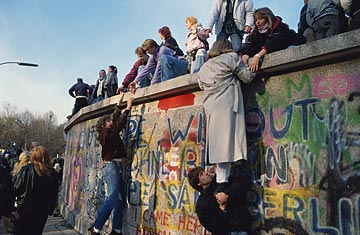
Crowds bear witness to the fall of the Berlin Wall on Nov. 10, 1989
(4 of 7)
The world has, or thought it had, become accustomed to change in Eastern Europe, where every week brings developments that would have seemed unbelievable a short while earlier. Nonetheless, the opening of the Wall caught it off guard. President George Bush, who summoned reporters into the Oval Office Thursday afternoon, declared himself "very pleased" but seemed oddly subdued. Aides attributed that partly to his natural caution, partly to uncertainty about what the news meant, largely to a desire to do or say nothing that might provoke a crackdown in East Germany. As the President put it, "We're handling it in a way where we are not trying to give anybody a hard time." By Friday, though, Bush realized he had badly underplayed a historic event and, in a speech in Texas, waxed more enthusiastic. "I was moved, as you all were, by the pictures," said Bush. He also got in a plug for his forthcoming meeting with Gorbachev on ships anchored off the coast of Malta: "The process of reform initiated by the East Europeans and supported by Mr. Gorbachev . . . offers us all much hope and deserves encouragement."
Gorbachev in fact may have done more than merely support the East German opening. It was no coincidence that Honecker resigned shortly after the Soviet President visited East Berlin, and that the pace of reform picked up sharply after Krenz returned from conferring with Gorbachev in Moscow two weeks ago. In pursuing perestroika -- in his eyes not to be limited to the U.S.S.R. -- and preaching reform, Gorbachev has made it clear that Moscow will tolerate almost any political or economic system among its allies, so long as they remain in the Warsaw Pact and do nothing detrimental to Soviet security interests. The Kremlin greeted the opening of the Wall as "wise" and "positive," in the words of Foreign Ministry spokesman Gennadi Gerasimov, who said it should help dispel "stereotypes about the Iron Curtain." But he warned against interpreting the move as a step toward German reunification, which in Moscow's view could come about only after a dissolution of both NATO and the Warsaw Pact, if at all.
West Germany, the country most immediately and strongly affected, was both overjoyed and stunned. In Bonn members of the Bundestag, some with tears in their eyes, spontaneously rose and sang the national anthem. It was a rare demonstration in a country in which open displays of nationalistic sentiment have been frowned on since the Third Reich died in 1945.