

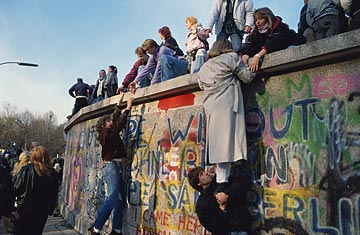
Crowds bear witness to the fall of the Berlin Wall on Nov. 10, 1989
(3 of 7)
When the great breach finally came, it started undramatically. At a press conference last Thursday, Schabowski announced almost offhandedly that starting at midnight, East Germans would be free to leave at any point along the country's borders, including the crossing points through the Wall in Berlin, without special permission, for a few hours, a day or forever. Word spread rapidly through both parts of the divided city, to the 2 million people in the West and the 1.3 million in the East. At Checkpoint Charlie, in West Berlin's American sector, a crowd gathered well before midnight. Many had piled out of nearby bars, carrying bottles of champagne and beer to celebrate. As the hour drew near, they taunted East German border guards with cries of "Tor Auf!" (Open the gate!).
On the stroke of midnight, East Berliners began coming through, some waving their blue ID cards in the air. West Berliners embraced them, offered them champagne and even handed them deutsche mark notes to finance a celebration (the East German mark, a nonconvertible currency, is almost worthless outside the country). "I just can't believe it!" exclaimed Angelika Wache, 34, the first visitor to cross at Checkpoint Charlie. "I don't feel like I'm in prison anymore!" shouted one young man. Torsten Ryl, 24, was one of many who came over just to see what the West was like. "Finally, we can really visit other states instead of just seeing them on television or hearing about them," he said. "I don't intend to stay, but we must have the possibility to come over here and go back again." The crowd erupted in whistles and cheers as a West Berliner handed Ryl a 20-mark bill and told him, "Go have a beer first."
Many of the visitors pushed on to the Kurfurstendamm, West Berlin's boulevard of fancy stores, smart cafes and elegant hotels, to see prosperity at first hand. At 3 a.m., the street was a cacophony of honking horns and happily shouting people; at 5 some were still sitting in hotel lobbies, waiting for dawn. One group was finishing off a bottle of champagne in the lobby of the Hotel Am Zoo, chatting noisily. "We're going back, of course," said a woman at the table. "But we must wait to see the stores open. We must see that."
Later in the day, two young workers from an East Berlin electronics factory who drove through Checkpoint Charlie in a battered blue 1967 Skoda provided a hint that Krenz may in fact have scored a masterstroke by relieving some of the pressure to emigrate. Uwe Grebasch, 28, the driver, said he and his companion, Frank Vogel, 28, had considered leaving East Germany for good but decided against it. "We can take it over there as long as we can leave once in a while," said Grebasch. "Our work is O.K., but they must now let us travel where we want, when we want, with no limits."