

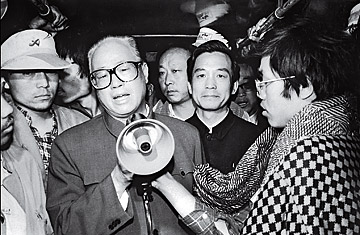
Knowing efforts will probably prove futile, Zhao pleads with students to "treasure their lives" and end their hunger strike.
(6 of 6)
Despite the government's assurances that it will continue to keep its doors open to the outside world, foreign trade -- $82.6 billion in 1988 -- can be expected to slide steeply in the next few months. Though China may want to trade, will anyone want to trade with China? As foreigners have fled the country, joint ventures with Western and Japanese firms are frozen. Even before the protests erupted, inflation, corruption and unemployment had put a brake on progress; hesitation by outsiders to invest in China will only exacerbate these problems. Said a senior British diplomat: "First, there is the revulsion factor in the wake of the bloodbath that will keep a lot of Westerners away. Second, there is the question of confidence. Deng built that up, and now it lies destroyed. No one is willing to invest unless there is reasonable assurance of stability. Restoring international confidence will be % one of the leadership's toughest tasks."
The task may be impossible without a wholesale change in the leadership, which is not likely soon. Deng was deservedly admired for having navigated China toward economic modernization, but his achievement is tainted by the blood of the demonstrators killed in Beijing. The aged conservative revolutionaries surrounding him are out of touch with a population whose majority is under 40 years of age. The P.L.A., contrary to its popular repute, has shown itself to be the regime's, not the people's, army. Said a senior British diplomat last week: "There is not a single institution that has not been besmirched in these past weeks." The threat of civil war has not entirely vanished -- if only as a psychological rather than an actual battle. The students' calls for democracy had unparalleled national support, which may have gone underground but will not go away. Perhaps 300,000 troops are still encamped around the capital. The Communist Party leadership is distrusted by large numbers of its own people. The men at the top have been condemned by the outside world as the enemies of the people.
Elsewhere in the Communist world, leaders like Mikhail Gorbachev and Poland's Wojciech Jaruzelski are trying to break old patterns by channeling unrest and rising expectations into a limited evolution toward more democracy. China's old men seem to have missed the message -- and sacrificed much to their desire to retain absolute power. Forced to choose between accommodating change and maintaining the regime, they chose tyranny.