

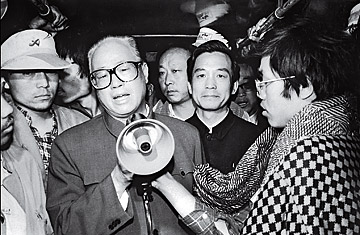
Knowing efforts will probably prove futile, Zhao pleads with students to "treasure their lives" and end their hunger strike.
(5 of 6)
Yang turned to the 27th Army, normally based in Shijiazhuang, Hebei province, and largely composed of ill-educated peasant conscripts with no ties to Beijing, for the harsh job of clearing Tiananmen. The President has personal links to the 27th through his brother Yang Baibing, who is top political commissar of the P.L.A., and Chief of Staff Chi Haotian, said to be another relative.
But what may have been planned only as a show of force turned into a bloodbath. Soon armed soldiers and unarmed protesters were locked in furious combat. Ruan Ming, a former lecturer on Marxism at Beijing's Communist Party School, argues that a propaganda blitz mounted by the government last week to justify the Tiananmen sweep was an attempt to "salvage the situation and save face."
As architects of the debacle, Li and Yang could eventually prove liabilities to Deng, and he might have to jettison them. An alternative could be provided by Qiao Shi, an unfamiliar Politburo member, who emerged as a rising star after a telegram from the Supreme Court congratulated him for his support of the military crackdown.
Little is known about Qiao, but he is thought to be one of the more politically agile members in the party elite. In the days leading up to the crisis, he reportedly abstained from a crucial vote when the party was paralyzed over how to act on the student protests. That demonstration of neutrality may have made him acceptable as a compromise leader to all sides. "He is a very shrewd man," says Ruan. "He was elevated to the Politburo by Hu Yaobang. But when Hu was ousted, Qiao acted against his former mentor and sided with Deng."
Yet the problem for Li, Yang, Qiao or anyone else trying to rule China in the post-Tiananmen era is not more street protests. In the few days after the massacre, demonstrations and strikes did erupt in several key cities -- from Shenyang in Manchuria to central Wuhan to southern Guangzhou. Students and workers set up barricades in Shanghai, China's largest city and economic hub, and paralyzed the public transportation system. But the activism soon petered out. Protest rallies shrank from the ten thousands to the tens. On Shanghai campuses, student associations dissolved. With the crackdown officially under way, the vast majority of people -- even in the once radical Shanghai -- have been frightened into nervous silence.
Putting down dissent through repression and propaganda is one thing; finding the road toward political and economic recovery quite another. In Beijing, much of the public transportation system has been destroyed or damaged. Losses to the national economy are estimated in the hundreds of millions of dollars. Japan, China's largest foreign-aid donor, has announced a halt in negotiations for a $120 million loan for an oil project. The U.S. and Britain have suspended all public and private arms sales to China for the foreseeable future: the P.L.A. alone needs to replace more than 300 vehicles smashed or burned in the taking of the square.