

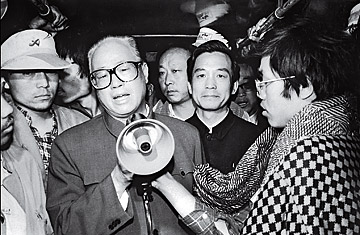
Knowing efforts will probably prove futile, Zhao pleads with students to "treasure their lives" and end their hunger strike.
(4 of 6)
Furthermore, soldiers on trucks careened through the diplomatic quarter, shouting "Go home! Go home!" Yet others sprayed bullets into the walls and windows of Jianguomenwai, a compound occupied by foreigners. One diplomatic analyst is convinced that under the cover of random gunfire, military snipers were deliberately shooting up apartments inhabited by diplomats who had the previous night disrupted what appeared to be preparations for a surreptitious execution of young Chinese men. "What they did in the foreign compound," said this intelligence expert, "was to attempt to drive out every foreign eye so they can go about their executions." Western photographers and television crews have been roughed up.
In fact, the expected confrontation between military factions never materialized. By the end of the week, 27th Army soldiers who had participated in the Tiananmen assault had decamped and were replaced by fresh troops from other regiments unconnected with the massacre. Only hours after Deng's appearance on TV, long columns of armor left the city. The military maneuvers served mainly to camouflage a deep political conflict. The massacre at Tiananmen may have been just a violent stage in the ongoing struggle of succession, not unlike the turmoil that has occurred throughout Chinese history whenever a dynasty waned.
For the past several years the Communist Party has been facing the question of who will ultimately replace Deng. He complicated the problem by purging his own chosen heir, the reform-minded party General Secretary Hu Yaobang, who was relieved of his job in 1987 for not quickly crushing student demonstrations. Hu's replacement as designated successor was Zhao, who now appears to have also fallen victim to Deng's displeasure.
Throughout his years in power, Deng balanced moderate vs. hard-line factions in every organ of the state -- the party, the government, the military. The result was paralysis: important decisions were frequently avoided or ignored. Deng remained the ultimate arbiter, but hobbled by age and his penchant for toughing out dilemmas, he increasingly played off would-be successors against one another, letting their disagreements fester into bureaucratic skirmishing.
The death of Hu last April precipitated a crisis. When expressions of grief sparked in Tiananmen the demands for greater democracy, differences between the factions left the leadership impotent to take a united stand on how to cope with an unprecedented event. As the leaders dithered, the protest swelled.
The students' modest calls for more democracy and less corruption not only confronted the leadership with fundamental questions about China's future direction but also created an opening for political jockeying. According to one theory, Zhao, 69, the leader reputedly most willing to adopt more open politics, took advantage of the situation to ask for greater authority. From Deng, Zhao reportedly sought the power to grant some of the students' demands. Sensing an attempt at a power play, Deng refused.
An internal document leaked through Hong Kong claims Deng then demanded action and the suppression of all perceived threats to the party's central authority -- namely himself. In spite of Zhao's refusal to support the imposition of martial law in Beijing, Deng pressed ahead with plans for military rule with Premier Li and President Yang.