

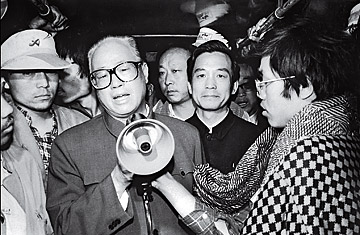
Knowing efforts will probably prove futile, Zhao pleads with students to "treasure their lives" and end their hunger strike.
(3 of 6)
The government's lurch backward to the thuggish practices of the Cultural Revolution may be the only way it knows to deal with another kind of madness: popular anger. At the time of the massacre, many citizens were so incensed that the P.L.A. was being used against the people that they ambushed stray groups of soldiers with fire bombs, bricks, clubs, even bare hands. Later, outgunned and powerless, the resistance turned to words. In the shadow of the Beijing Hotel, a young man spotted a military helicopter hovering over Tiananmen and wrathfully wished destruction on it. "Fall down!" he cried. "Fall down!" Across the square, a worker stared angrily at a group of soldiers and muttered, "So many died, but not in vain. It's not over yet, just you wait. We'll get you in due time."
Other vengeful visions proved illusory. When units of the 38th Army, a contingent normally based in Baoding, rolled into the city three days after the Tiananmen bloodletting, residents cheered them on, hoping they would drive out the hated 27th. "Let it be blood for blood!" shouted bystanders. But the 38th Army supported the 27th and martial rule.
After a decade of reform that the Chinese had hoped would lead to steady economic and social progress, why had chaos and barbarity suddenly descended on Beijing? No answer had meaning for long. Even as Li and Yang appeared at Deng's side, speculation was rife that the Premier and the chief of state were dispensable. Rumors about Deng's frail health were not resolved by his appearance on television: his left hand trembled, his face was puffy, his eyes ringed with dark circles. But as he spoke, his words grew in coherency and exuded authority. At one point, he dismissed an unwanted bit of prompting from Li with a withering look.
As the week wore on, it appeared that whatever power Deng and his colleagues held came from the guns of the P.L.A. Intelligence specialists believe the army has played a role not only in securing the capital but also in preparing for further repression. One possible goal: to scare off prying foreigners.
Constant and mysterious military movements stirred confusion and alarm. Tank convoys rumbled to the east, away from Tiananmen, only to return a few hours later. Armored vehicles were deployed at a strategic cloverleaf east of the square, as if awaiting attack by another military force. Rumors of skirmishes, even artillery duels between the "bad" 27th Army and the "good soldiers" of the 38th Army, fluttered through the capital. With fear of an armed confrontation rampant, foreign governments ordered the evacuation of their nationals. Beijing airport was packed with diplomats, tourists and businessmen waiting for tickets and specially chartered planes to leave a capital seemingly under siege.