

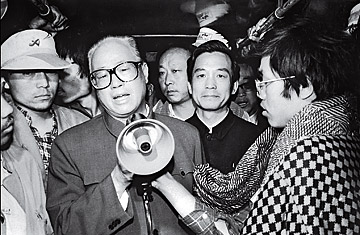
Knowing efforts will probably prove futile, Zhao pleads with students to "treasure their lives" and end their hunger strike.
(2 of 6)
From June 4 to June 8, as the leadership was enveloped in an unseen struggle for power, the world searched for signs of reason amid the turmoil. The country's rulers finally began to re-emerge, but not reason and not humanity. First came Premier Li Peng, 60, the front man for the regime's hard-line faction, giving the lie to rumors that he had suffered a gunshot wound. On TV he praised the soldiers who had killed and maimed to wrest the capital from the demonstrators. "Comrades, you must be exhausted," Li said. "Thank you for your hard work."
At about the same time, the government issued harsh martial-law decrees ordering leaders of the prodemocracy movement, "important figures who incited and organized this counterrevolutionary insurrection in the capital," to turn themselves in for "lenient treatment." The decrees set up a spy-and-report network, complete with 18 telephone hot lines, so that citizens could help round up dissidents. Fearful of arrest, student leaders who had survived the carnage went underground or fled the city. The astrophysicist Fang Lizhi, a leading dissident who was prevented by the government from dining with George Bush during the President's visit last February, sought refuge in the U.S. embassy; the presence of the "traitor" there provoked Chinese complaints of American meddling.
The next day Deng, 84, China's supreme ruler for the past decade, made his first appearance on television in nearly a month. At his side were Li and a host of top leaders and party elders, as well as representatives of all key factions in the military, including those who had been considered loyal to party moderates. Present too were President Yang Shangkun, 82, a former army general and the reputed mastermind of the Tiananmen attack, and Qiao Shi, 64, the state security chief who may become General Secretary of the Communist Party. Conspicuously missing was the incumbent in that post, the moderate Zhao Ziyang, whose whereabouts have remained unknown since late last month, when he held sympathetic talks with student representatives in Tiananmen. The officials applauded as Deng hailed the soldiers. "Facing a life-threatening situation," he said, "our troops never forgot the people, never forgot the party, never forgot the country's interest." He had condolences for the families of soldiers killed during the upheaval but not a word for the victims in the protesters' ranks.
By then the arrests had started. All over Beijing, Chinese who had Western friends began to disappear, either into hiding or, in increasing numbers, into jails. In one incident opposite the foreign-community compound of Qijiayuan, some 30 Chinese were taken in by security forces. In another part of town, 28 more were led away. "It is the night of the long knives," said a Western diplomat. The total in custody at week's end: 400.