

(8 of 9)
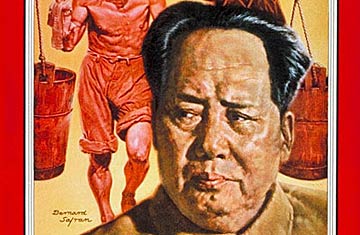
Inevitably the U.S., as the most powerful of Western nations, has been declared the focus of Chinese hatred and resentment. With an ignorant arrogance that could have disastrous consequences for the world, Peking's rulers dismiss the U.S. as a "paper tiger," pooh-pooh the U.S. H-bomb. Four years ago Red China's War Minister confidently told Sam Watson, former chairman of the British Labor Party: "Even if 200 million of us were killed, we would still have 400 million left." Mao himself makes no bones of his ambition to "drive the U.S. out of East Asia," recently told a Brazilian journalist: "We must attack the tiger again and again until we finally kill it."
All for Australia. Dangerous as it may be for the non-Communist world, Red China's rise to great-power status is no unmixed blessing to Soviet Russia. Many Chinese visibly resent their industrial dependence on the Soviets. Even Mao, by stressing the fact that all Russian "aid" has been paid for by China, emphasizes the U.S.S.R.'s niggardliness. The bellicose men of Peking also realize that Russia has not yet seen fit to supply them with atomic weapons.
Ideologically, too, there are tensions between Peking and Moscow. Chinese Reds privately consider Khrushchev a waverer whose understanding of Marxism-Leninism leaves much to be desired. "The Russians are always blundering," one Chinese Communist loftily told British Journalist Dennis Bloodworth. "Weak Soviet policy was responsible for the Hungarian revolution and the trouble in Poland." Not having been afraid of differing from Stalin, Mao has never hesitated to differ from the Johnny-come-latelys now in authority in Moscow. The Russians officially proclaim Mao to be "a major Marxist-Leninist theoretician,'' but his writings are not required reading among Russian party members, and his major pronouncements are dutifully printed without endorsement or criticism. An embarrassed silence greets Mao's current claim that his people's communes will bring true Communism to China in the foreseeable future, since after 41 years the Russians have yet to make such a leap to "true Communism."
What the Russians have to fear from Mao's China is not that it will desert to the West or "pull a Tito," but that it will one day seize leadership of the Communist world. In public, Russian leaders are determinedly cheerful about their relations with Peking, but three weeks ago U.S. Pundit Walter Lippmann returned from a trip to Moscow to report that Russian reactions to China's "great leap forward" varied between "awe and anxiety." The vast geographical vacuum between the two countries is being competitively filled—by Khrushchev's reclamation of the Central Asian "virgin lands," and by China's intensive colonization of Sinkiang province, once a Soviet zone of influence. When Britain's Sam Watson forecast to Khrushchev that the Chinese would one day flood either north into Siberia or south into Australia, Khrushchev's reply was: "I'm all in favor of Australia."