

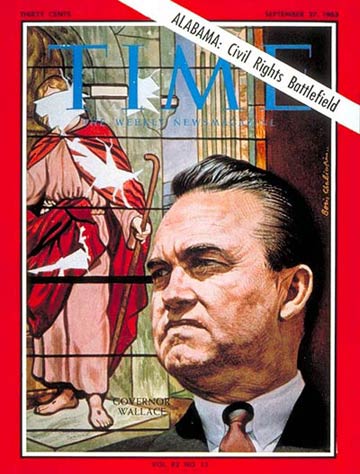
Alabama Gov. George Wallace
(4 of 7)
New Deal. He was born in the Barbour County town of Clio (1962 pop. 900). His father, a member of the county board of revenue, died at 40, leaving George to help support his mother. He was a little kid (today he stands 5 ft. 7 in., weighs 150 Ibs.), and a tough one. In high school he became a 98-lb. quarterback on the varsity football team, won Alabama's bantamweight Golden Gloves championship in 1936 and 1937, later fought professionally in one-night stands in tank towns.
Wallace earned his way through the University of Alabama driving taxicabs and slinging hash. He was a big man on campus, a smiling gladhander with the ability to get good grades without excessive study, and he was fascinated by politics. Wallace was, among other things, an ardent New Dealer. Recalls George LeMaistre, who taught Wallace in law school: "In his mind, Franklin Roosevelt couldn't do anything wrong."
When he got out of law school, Wallace could not afford to set up a law practice. He collected 1,000 coat hangers, sold them and his old clothes, lived on the meager proceeds until he got a job — driving a dump truck. He was still piloting the truck at 23, when he met a clerk in a dime store named Lurleen Burns, 16. They were married in May 1943 and now have four children.
After serving in the Air Force as a B-29 crew member (nine combat missions in the Pacific), Wallace returned to Alabama, put on his political boxing gloves and began slugging. He talked himself into a job as state assistant attorney general, and in 1947 was elected to the legislature. There he sponsored a series of New Dealish bills aimed at helping Alabama in its desperate reach for prosperity.
Snoopers. In 1952 Wallace ran successfully for circuit judge in the third judicial district. In no time at all, he was inviting the Federal Government to step into the ring and put up its dukes. In 1958, during an investigation of voting rights, Wallace defied a federal court order to hand over records to the Justice Department. Instead, "the Fighting Judge," as he came to be called, threatened to imprison any FBI agent who invaded his circuit on a "snooping" mission.
That occasioned the first of George Wallace's several retreats in the face of federal authority. The federal judge was Frank Johnson Jr., an old university buddy and he again ordered Wallace to produce the records. Wallace refused. Johnson then issued a show-cause order, threatening Wallace with contempt. There ensued a hearing, after which Johnson dismissed the contempt citation—on the ground that Wallace had in fact "through devious methods assisted said agents in obtaining" the records. To this day, Wallace insists that it did not happen that way. "This Washington crowd had the federal judge back down," he protests. "When and if they say they didn't back down, they are integrating, scalwagging, carpetbagging liars."