

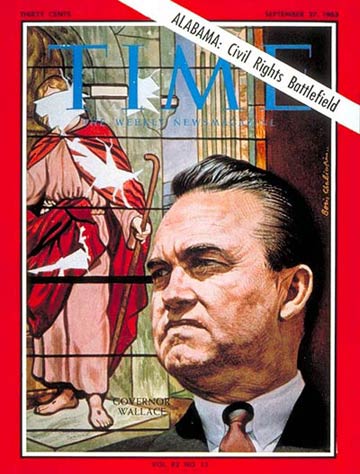
Alabama Gov. George Wallace
(2 of 7)
The Brooding State. Why, indeed, didn't he? The answer can partly be found in the life and personality of George Wallace himself. But it can only have real meaning when understood alongside the history of Alabama, a dark and brooding state. Back in the oldtime slave days, the conjure women used to say that the state's destiny was firmly fixed on an awful night long before, when stars fell on Alabama—in a huge, scarring meteoric shower. Alabamians still tell that legend on themselves—and in a curious way it explains much about Alabama as a state of deep superstitions, fierce prides, sudden violence and voiceless fears.
An Immense Irony. With cotton as king and the Negro as slave, Alabama was in the forefront of the secessionist movement that led to the Civil War. It was in Montgomery that the South established the Confederacy and made Jefferson Davis its President. Proudly, Alabama sent about 120,000 men—nearly all of its male white population —into the Civil War. Proudly, it boasted 39 generals. Proudly, it was vanquished.
But unlike many of its sister Southern states, Alabama suffered few ravages from Union troops; indeed, the most notable battle came on the water, with Farragut's damn-the-torpedoes victory in Mobile Bay. What the war did do was rip the foundations from beneath Alabama's cotton-based economy. And what the Civil War did not finish, the boll weevil did.
As a state, Alabama came to know the darkest sort of poverty and to experience the bitterness and hatred that such poverty can inspire. Even today, Alabama rates 47th among the states in per capita income ($1,538), leading only Arkansas, South Carolina and Mississippi. And, at a time when George Wallace is inveighing against the Federal Government in the name of states' rights, the extent to which Alabama depends on economic help from the Government is an immense irony.
When cotton ceased to be king, Franklin Roosevelt and the New Deal took its place. The issue of federal v. state sovereignty was all but buried under the weight of federal dollars for public power, military installations, dams, forests and scads of pork-barrel projects. (In 1962 the U.S. Government poured $229 million in grants-in-aid into Alabama.)
The northern tier of Alabama, once pathetically barren, now flourishes under the spur of the Tennessee Valley Authority's cheap public power and of the mushrooming U.S.-financed space-age industries. The missile city of Huntsville, with its glistening new office buildings is the jewel of the valley area. During the decade of the '50s, it almost quintupled in population, now approaches 100,000. West of Huntsville, the tri-cities complex of Florence, Sheffield and Tuscumbia is bursting with new heavy industry, while southeast is Guntersville, a thriving resort area that features fine fishing, sailing and impressive scenery. There, too, along the Tennessee River, is a splendid rolling countryside and good red earth that produces much of Alabama's annual 700,000-bale cotton crop.
Across the whole valley, the federal presence has created the most economically and racially stable section of Alabama. A few months ago, for example, Huntsville desegregated its eating places with hardly a segregationist howl to be heard.