

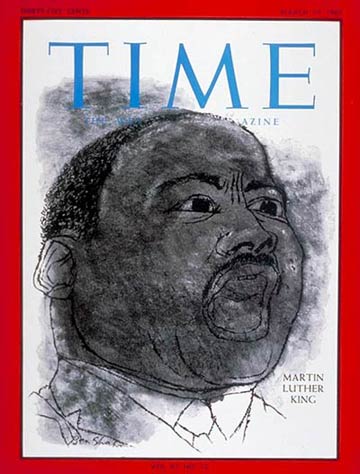
(9 of 11)
Selma Lawyer W. McLean Pitts, attorney for Sheriff Clark, demanded that the court cite Martin Luther King for contempt. The judge leveled a cold eye at Attorney Pitts, explained with asperity that contempt is a matter for the court to decide.
Questioning Negro witnesses, Pitts was aggressive to the point that N.A.A.C.P. Lawyer Jack Greenberg, representing King, jumped to his feet to object to Pitts's "insulting manner." Judge Johnson sustained Greenberg. "Everybody in this court, regardless of who he or she is, will be treated with common courtesy," said he.
Pitts sputtered: "I'm trying very hard, but . . ."
Johnson shot back acidly: "Try a little harder."
Condemning the Robbed. On the stand, King described the events of Tuesday, when he was confronted with the federal order to postpone the march. "I was very upset," he explained. "I felt it was like condemning the robbed man for being robbed. I was disturbed. Thousands of people who had come to Selma to march were deeply aroused by the brutality of Sunday. I felt if I had not done it, pent-up emotions could have developed into an uncontrollable situation. I did it to give them an outlet. Maybe there will be some blood let in the state of Alabama before we get through, but it will be our blood and not the blood of our white brothers." He had been assured by LeRoy Collins, King added, that "everything will be all right."
"Is it correct to say that when you started across the bridge," asked the judge, "you knew at that time that you did not intend to march to Montgomery?" Replied King: "Yes, it is."
"You Ought to Be Thinking." As the hearings proceeded, demands for federal action intensified. Lyndon Johnson was concerned. Meeting for four hours with a delegation of 16 civil rights and religious leaders, he rejected suggestions that he send federal troops into Selma. "Everybody talks about my reluctance to use troops in Selma," he said. "And as President, I am reluctant to use the strength of the defense establishment for such a thing. When you sit in this chair, you think three times before you say 'go.' " But he also disclosed that "in the wee hours of Tuesday morning, I signed all the necessary orders to have 700 troops get ready to move into Selma."
By week's end, Johnson was convinced that a presidential statement to the nation was in order, and he determined to make the Government's position unmistakably clear. Governor Wallace, who had remained largely incommunicado during all the ruckus, suddenly surfaced—and provided the President with the perfect opportunity to clear the air. In a telegram to the President, Wallace continued the fiction that "voter registration and voting rights are not the issues," requested a meeting with Johnson at the earliest possible time.
The President replied swiftly: "I will be available in my office." On Saturday morning Wallace entered the White House for a conference that lasted more than three hours. The two had what is politely called a "friendly exchange of views," but there was no