

(3 of 11)
"Please! No!" begged a Negro as a cop flailed away with his club. "My God, we're being killed!" cried another. The Negroes staggered across the bridge and made for the church, chased by the sheriff's deputies and the horsemen. Many Negroes picked up cans and rocks and hurled them at the police. As the deputies crowded in, they were stopped by Selma's Public Safety Director Wilson Baker, a bitter enemy of Clark's who has done his thankless best to keep peace in the city. Said Baker to Clark: "Sheriff, keep your men back." Replied Clark: "Everything will be all right. I've already waited a month too damn long!"
Off the Streets. But Clark did, however grudgingly, disperse his men. Thereafter they amused themselves by stalking along the downtown streets, beating on the hoods of Negroes' cars and ordering "Get the hell out of town. We want all niggers off the streets." Reported the Selma Times-Journal next day: "Thirty minutes after the marchers' encounter with the troopers, a Negro could not be seen walking the streets." All told, 78 Negroes required hospital treatment for injuries.
Rarely in history has public opinion reacted so spontaneously and with such fury. In Detroit, Mayor Jerome Cavanaugh and Michigan's Governor George Romney led a protest parade of 10,000 people. In Chicago, demonstrators blocked rush-hour traffic in the Loop. Nearly 2,000 people marched in Toronto, 1,000 in Union, N.J., 1,000 in Washington. In California and Wisconsin, in Connecticut and New York, citizens streamed onto the streets to express their rage.
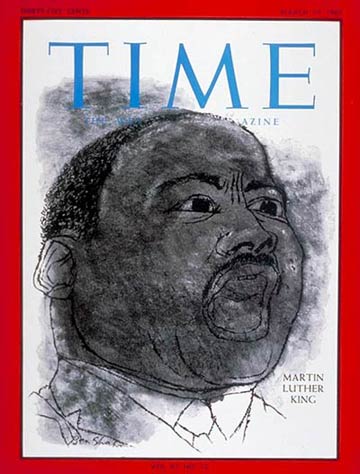
President Johnson publicly declared that he "deplored the brutality" in Selma—and urged Selma's opposing sides to cool down. And in Atlanta, Martin Luther King announced that as a "matter of conscience and in an attempt to arouse the deepest concern of the nation," he was "compelled" to lead another march from Selma to Montgomery. He called it for Tuesday, March 9.
"Charge!" The response was phenomenal. In city after city, white clergymen dropped what they were doing and headed for the nearest airport. In Indianapolis, A. Garnett Day Jr., an official of the Disciples of Christ, was about to emplane for New York when he heard that King was calling for help. Day walked back into the terminal, bought a ticket for Alabama. Also in Indianapolis, Jewish Mission Worker David Goldstein had an appointment to seek a salary raise from his boss; he canceled it and headed for Selma. California's Episcopal Bishop James Pike interrupted a trip to New Orleans and flew into Alabama. Methodist Bishop John Wesley Lord, vice president of the National Council of Churches, came from Washington, D.C.; so did