

(2 of 11)
Then, one night in nearby Marion, 50 state troopers and a band of rednecks routed 400 Negro demonstrators. In the fight, a young woodcutter named Jimmie Lee Jackson was shot in the stomach; he died eight days later, after declaring that a state trooper had gunned him.
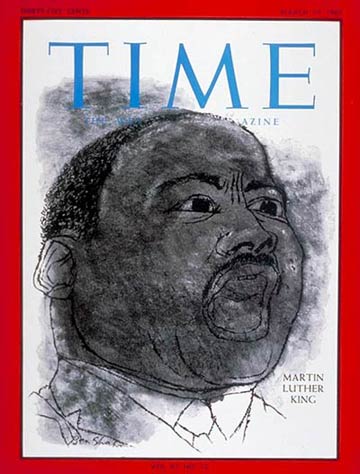
Selma's Negroes had a martyr, and King called for a march from Selma to the state capitol at Montgomery, 50 miles away. "I can't promise you that it won't get you beaten," cried King to his followers. "I can't promise you that it won't get your house bombed. I can't promise you won't get scarred up a bit. But we must stand up for what is right!" King planned to lead the march himself, but at the last minute was persuaded by aides to stay at his Atlanta headquarters for his safety's sake.
Hard Hats & Gas Masks. The march took place on the afternoon of Sunday, March 7. Ignoring an order from Governor Wallace forbidding the march, 650 Negroes and a few whites assembled at the Brown Chapel African Methodist Episcopal Church on Selma's Sylvan Street. Leading them were John Lewis, militant head of the Student Non-Violent Coordinating Committee (S.N.C.C.), and Hosea Williams, an official of King's Southern Christian Leadership Conference. Two abreast, many of them laden with bedrolls and knapsacks, the Negroes filed through the back streets of Selma, turned onto Broad Street, and headed for the Edmund Pettus Bridge, which crosses the Alabama River.
On U.S. Highway 80,400 yards beyond the bridge, was a phalanx of 60 state cops, headed by Colonel Al Lingo, an old crony of George Wallace's and a segregationist of the Governor's own stripe. The troopers stood three-deep across all four lanes of the highway. They wore dark blue shirts, sky-blue hard hats, carried billy clubs, sidearms and gas masks. On the sidelines were Sheriff Clark's possemen, both on horseback and afoot, ready, willing and eager for trouble.
When the Negro columns came within 100 yards, a state police officer ordered the troopers to put on their gas masks. At 25 yards, the Negroes halted. State Police Major John Cloud barked through a bullhorn: "Turn around and go back to your church! You will not be allowed to march any further! You've got two minutes to disperse!"
The two minutes ticked by as the masked troopers stood in stony suspension, feet spread, arms down, holding their clubs at both ends. The Negroes stared at them somberly. Then Major Cloud gave the order: "Troopers—forward!" The patrolmen moved in a solid wall, pushing back the Negroes. The marchers in front began to stumble and fall, and a few troopers tripped.
Smoke & Blood. Suddenly the clubs started swinging. From the sidelines, white townspeople raised their voices in cheers and whoops. Joined now by the possemen and deputies, the patrolmen waded into the screaming mob. The