

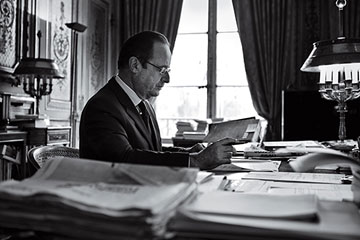
Hollande, at work in his Élysée Palace office, may wield more executive power than most other Western leaders, but he cannot ignore the street.
(5 of 5)
For a President seeking to reduce spending, Hollande has been quick to commit to expensive and open-ended operations. "I could, of course, have limited my actions to purely domestic issues," he acknowledges. But he adds, "Even during this very difficult period, I wanted to demonstrate that France could assume its full responsibility on a global scale, no matter the area: human, financial, political ... My message is, France is right there."
Geopolitically speaking, that's true. France has the largest Arab population of any West European country because of a colonial history that bequeathed it deep and complex ties with Syria and the Maghreb. When others broke off diplomatic relations with Iran, the French kept channels open. One constant feature of French foreign policy is its exceptionalism. France rarely falls into line, as successive U.S. Administrations have discovered. Hollande, who hasn't yet locked horns with the U.S., characterized the relationship thus: "France is a solid ally of the United States but always retains its independence."
President Jacques Chirac, in refusing to join the Iraq War, created anger and consternation in Washington. His decision means Hollande travels to the U.S. unburdened by the popular backlash against interventionism that has constrained other leaders. Following revelations that the NSA targeted French citizens, he also expects to arrive with leverage "to build a new cooperation in the field of intelligence."
Cherchez la Femme
Hollande's advisers will doubtless be irritated by continuing press interest in the absence of a female companion to balance out his photo call with the Obamas. Inside the Élysée Palace, there's little sympathy for the view that Hollande's private life is of public interest.
But the attention might not be a bad thing. Since his love life hit the headlines, Hollande's rock-bottom ratings have edged up, if only slightly. That may partly reflect approval for his proposed responsibility pact, but the alleged affair has also made him "appear more human and closer to the people," Axelle Lemaire, a Socialist French lawmaker, suggested to the London Evening Standard. Images of a helmeted Hollande on a scooter puttering the two blocks from the Élysée to supposed trysts are a far cry from the posturing of his predecessors. He appears approachable, faintly ridiculous, not a republican king handing down orders from his palace but an ordinary citizen, something that may make his message of mutual sacrifice more palatable to his compatriots.
And if his opponents underestimate his resolve in the face of ridicule, so much the better. They have already done so to their cost. After months of violent street protests, Hollande last May pushed through a law legalizing gay marriage and granting adoption rights to gay couples. History, though, remains stacked against anyone who tries to haul France in any one direction too quickly. Mitterrand never got his school reform through. Sarko threw in the towel on his ambitions to inject a more entrepreneurial spirit into the country that gave the world that word. Hollande--an unexpected President, unlikely reformer and unanticipated focus of tabloid fascination--needs to have a few more surprises up his sleeve.