

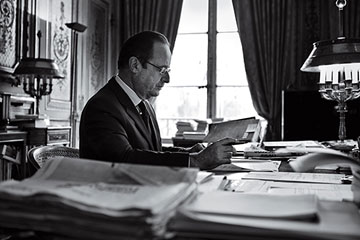
Hollande, at work in his Élysée Palace office, may wield more executive power than most other Western leaders, but he cannot ignore the street.
(2 of 5)
As Hollande is learning, the palace walls have grown increasingly transparent. That's good news for anyone fascinated by his relationship tangles--and that would appear to be a surprisingly big audience. But it's a sobering thought for anyone with an interest in the French recovery--and that's a far broader swath of the planet. In becoming President, Hollande became the embodiment of France. His success or failure is bound up in the success or continued decline of his country. Amid gossip and sniggers, with the lowest poll ratings of any French leader in 50 years, the mild-mannered politician looks like an unlikely economic miracle worker. That might just count in his favor.
Hollande Exposed
In a 2012 campaign video for Hollande, Gayet lauded "the force of his oratory." But most fans admit that the President is more impressive in person than on a podium. A onetime economic aide to the Fifth Republic's first Socialist President, François Mitterrand, Hollande was nicknamed Flanby after a brand of custard pudding for his low-key, soft-edged style. In 2006, he sought the Socialist Party's presidential nomination, only to be overtaken by his long-term partner and the mother of his four children, Ségolène Royal. (After Royal lost the following year's presidential election to Nicolas Sarkozy, it transpired that she had already lost Hollande to Trierweiler.) When the Socialists began preparing for the next presidential contest, hopes rested not with Hollande but with the managing director of the International Monetary Fund, Dominique Strauss-Kahn. His 2011 arrest in Manhattan, on allegations--which he denies--of sexually assaulting a hotel maid, catapulted Hollande back into the frame.
A tide of discontent carried him over the finish line. Sarkozy, or "Sarko," suited the boom times. He was flashy and pugnacious, with a watch reputed to have cost $74,500, a gift from his supermodel turned musician First Lady, Carla Bruni. But in the bleak spring of 2012, his "bling bling" angered voters, persuading just enough of them to gamble on Hollande, who positioned himself as "Monsieur Normal" and promised to champion ordinary people. During his nearly two years in office, he sought to do so by favoring economic stimulus over budget discipline and targeting tax increases on the very rich, some of whom, like movie star Gérard Depardieu, chose to leave the country.
The past weeks have exposed a Hollande whom only his closest intimates had previously glimpsed. Not on account of his love life: by the standards of most ex-Presidents, including Mitterrand, who maintained two families and numerous liaisons, Hollande appears to be a paragon of restraint, on a par with Sarko, who merely divorced and remarried in office. But the January relaunch of Hollande's presidency saw him discard more than a few ideological veils.
He has pledged to slash public spending by $68 billion between 2015 and 2017. He has also proposed a "responsibility pact" with businesses to cut taxes and red tape in exchange for a commitment to create jobs and boost training.