

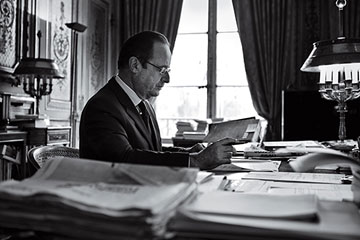
Hollande, at work in his Élysée Palace office, may wield more executive power than most other Western leaders, but he cannot ignore the street.
(3 of 5)
These are pledges the business community has longed to hear. "It's a very major move," says Pierre Gattaz, president of MEDEF, France's employers' union. "We can create 1 million jobs if we can solve some [of these] problems." To Hollande's core constituency of middle- and lower-income voters, his new direction could seem like a betrayal. Leftist leader Jean-Luc Mélenchon labeled the plans "a gift to companies." The President rejects notions that he has departed from his Socialist roots. Unchecked public spending, Hollande says, "was not stimulus. It was submission, acceptance ... It was just the easy way out."
He believes that voters' priorities have changed. "The French people are now saying we want lower spending," he tells TIME, "but on condition that there is a purpose, that it creates jobs, that it improves competitiveness, that it contributes to investment."
French Toast
"Let the crisis attain its paroxysm to be able then, only then, to resolve it," said Mitterrand as he attempted to pilot far-reaching reforms of the French school system in the 1980s. He calculated that his compatriots could be persuaded to embrace reform only by staring into the abyss. Hollande has refashioned that principle into an Obama-like narrative of hope and change, inspired in part by his memories of travel to New York City--"a huge, fascinating city, dirty and violent"--in 1974. The speed with which New York City transformed provides an example that Hollande aspires to emulate. He speaks of resilience, "where you suffer and then you become stronger ... A great nation can go through setbacks, but what makes it a great nation is that it can become a leader again very quickly. And it's the timescale that we have to shrink," he says, breaking into English to emphasize the point: "Plus que 'Yes we can,' ce devrait être 'Yes we can faster.'"
Few would doubt that a speedy upturn in France's fortunes is vital. Hollande acknowledges that "the hope cannot be based on pure sand, on illusions just to lull the children to sleep. We have to show our capacity to carry out the reforms." Yet a mix of circumstance and history weigh against full-throttle change.
The year ahead is dotted with elections: for municipalities, the European Parliament and the French upper house, the Senate. Deep cuts and broad reforms risk sending voters into the arms of other parties--including the far-right National Front, which, like other Euroskeptic, anti-immigration movements, has gained from turbulence in the euro zone.
But the roots of France's crisis run deeper than the woes of the single currency. The public sector remains outsize compared with its mission. The Banque de France, the country's central bank, lost much of its reason for being with the founding of the European Central Bank in 1998, but with 13,000 employees it remains the largest in the euro zone. Meanwhile, jobs growth in the private sector is sluggish. French companies are powerhouses abroad, but at home they have the lowest margins in Europe. "With lower margins, you invest less, hire less, do less marketing and basically are at a huge disadvantage," says Adrien Schmidt, CEO of Squid Solutions, a Big Data startup in Paris, and president of Silicon Sentier, an association for startups.