

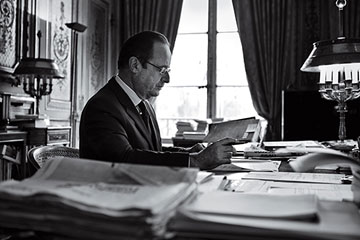
Hollande, at work in his Élysée Palace office, may wield more executive power than most other Western leaders, but he cannot ignore the street.
(4 of 5)
If taxes and labor laws make it expensive for employers to create jobs, it's sometimes even more costly to shed them. Take the U.S. tire manufacturer Goodyear, which had planned to close its factory in Amiens, 90 miles (145 km) north of Paris. Staff unhappy with the way the closure was handled took the company to court in Ohio, and on Jan. 6, union activists kidnapped two of their bosses in Amiens for two days. Two weeks later, unions and management settled on severance packages that reportedly offered between $163,000 and $176,000 per laid-off employee.
French workers expect benefits that are far more generous than those in the U.S. and most other European countries. But such largesse can't be funded through meager French GDP growth, estimated at 0.4% in the last quarter of 2013. The cost comes in higher rates of joblessness, especially among the young, and bills that can be paid only by raising taxes or borrowing. The result is a rising debt-to-GDP ratio. But unlike peripheral euro-zone countries that have seen their borrowing costs soar, France has seen yields on its benchmark 10-year government bonds drop to 2.22%. One explanation is that the markets believe affluent Germany will never allow its neighbor and fellow champion of the European project to flounder. This has reduced the pressure on France to change. Hollande gives a more buoyant assessment. Moody's Investors Service has reconfirmed that France's credit rating is set to remain stable at Aa1, two years after the country lost its membership in the AAA club. The President interprets this as good news: the rating hasn't slipped further. The glass is half full, not half empty.
A Fighter, Not a Lover
Hollande is a bona fide optimist, and his can-do spirit drives his foreign policy. Last September, Hollande arrived in Mali to see a democratic President sworn in after French troops had crushed Islamist rebel forces and was garlanded as a savior. He characterizes the military action he ordered to contain the spread of Islamist rule and stop the capital city of Bamako from falling to jihadists as "the most successful [intervention] ... in the history of military operations over the last 20 years." He knew strikes in Mali would be difficult without the backing of Algeria, the region's military superpower, but unresolved antagonisms between France and its former colony mitigated against such an agreement. In December 2012, Hollande traveled to Algiers, made a heartfelt address to the Parliament acknowledging the atrocities of the Algerian war and won over the notoriously dour President Abdelaziz Bouteflika. "Hollande is a mixture of strong resolve and smiley, lighthearted attitude, which usually makes people feel at ease," says Jean-Pierre Filiu, a former diplomat who accompanied Hollande to Algeria. "After two minutes with Hollande, even Bouteflika was smiling and laughing."
French boots have been on the ground in the Central African Republic since December, in a U.N.-backed operation to try to halt a bloody civil conflict, and French troops are still in Mali and Chad. Hollande had also scrambled his forces into readiness for strikes on Syria in tandem with the U.S. when a Russian-brokered deal on chemical weapons led to an 11th-hour change of plan.