

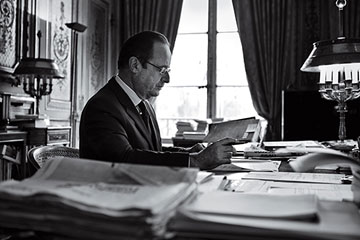
Hollande, at work in his Élysée Palace office, may wield more executive power than most other Western leaders, but he cannot ignore the street.
French Presidents don't so much govern as reign from the splendors of the Élysée Palace. They have powers most democratic leaders only dream of, able to deploy their military or command nuclear strikes without first consulting the national legislature. Yet François Hollande, like his predecessors, faces a defining question: Can he, will he, fix France?
That's because the French love revolution but hate reform, and the power invested in their heads of state is still ranged against the noisier forces of the street. Even as Hollande works the levers of the Élysée, Paris once again fills with protesters. A "Day of Anger" on Jan. 26, loud and inchoate, brought together thousands of people with different gripes who denounced everything from Hollande's economic plans, with which some disagree, to his private life, of which some approve. On Feb. 2, tens of thousands converged again, protesting his pledge to enable fertility treatment for gay couples, which forced him to delay the legislation.
Hollande's romantic woes have generated worldwide headlines, but it's his economic plans that have implications well beyond his borders as he prepares for a state visit to the U.S. on Feb. 11. The performance of the world's fifth largest economy, home to 31 of the world's biggest corporations--including energy giant Total and cosmetics company L'Oréal--affects not only the well-being of its own citizens but the fragile global recovery. Foreign investment in France plunged 77% last year, while unemployment hit 3.3 million in December. The public sector has been allowed to grow unfettered for decades, representing some 57% of GDP. The government is France's largest employer.
There was, therefore, relief in capitals from Washington to Berlin on Jan. 14 when Hollande, flanked by his ministers in the Élysée's cavernous function room, the Salle des Fêtes, set out plans to cut the bloated state and make France more business-friendly. This marked a sharp change of direction for a President elected on a Socialist Party ticket. In a Jan. 25 interview, he told Time that he has no accompanying desire to trim French ambitions down to size. As commander in chief of the largest military in Europe, he has sent troops to address savage conflicts in West and Central Africa, supported U.S. efforts in Syria and helped wrest concessions from Iran.
The President is a key global player, but he's uncomfortably aware that attention is focused on another part of his life. Since Jan. 10, the celebrity magazine Closer has tossed aside the French convention of respecting the personal privacy of public figures by publishing details of the 59-year-old President's alleged affair with 41-year-old actress Julie Gayet. Perched gingerly on a damask sofa in the presidential palace, Hollande flushes visibly when asked about his predicament. "Private life is always, at certain times, a challenge," Hollande says, and his is just beginning: hours after speaking to TIME he issued a terse statement confirming a split with the First Lady, journalist Valérie Trierweiler. In interviews on Jan. 30, Trierweiler indicated that she may write a memoir covering her time in the Élysée, which she described as "a world where betrayal pays."