

(7 of 8)
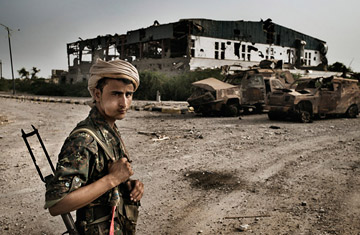
It doesn't help that AQAP is far from Hadi's only concern. The province of Abyan requires major rebuilding, well beyond Yemen's modest resources. (The country's per capita GDP is $2,300.) AQAP was not the only rebel group emboldened by last year's instability--a long-simmering separatist movement in the south has also gained strength. There were two Yemens until unification in 1990, and many southerners want independence again. Aden's walls are painted with the old South Yemen flag and slogans calling for its return. In the north, a Shi'ite insurgent group known as the Houthis has consolidated its control over large areas north of Sana'a. Each of these groups is too large--and, unlike AQAP, enjoys too much local popularity--to be easily pacified by military means.
And then there's Yemen's corruption-ravaged economy, with unemployment estimated at some 40% and inflation anywhere from 10% to 20%. A group of international donors known collectively as Friends of Yemen has pledged $4 billion in aid--the largest portion of it from Saudi Arabia--but a crucial meeting was postponed from June to September, leaving Yemenis doubting the money will materialize. For all its focus on Yemen, a White House consumed with re-election and in the process of withdrawing from Afghanistan is in no position to lead another nation-building exercise.
As if that were not enough, Hadi must also bind the wounds from the 2011 protests and craft a new constitution before elections are held in 2014. "The Americans want him to keep focusing on AQAP, but that is not a reasonable expectation when Yemen has so much else to worry about," says Mohammed Abulohom, a tribal sheik and politician. "He delivered Abyan, and the terrorists are on the run. Who can blame him if he now decides to give some attention to creating jobs or dealing with the electricity shortage?"
For now, Hadi remains determined to press home his military advantage over the retreating AQAP. Unlike Saleh, he has shown no inclination to use the jihadist bogeyman to extract more money from the U.S. "[Hadi] has moral conviction on this, and he's never tried to exploit it for political gain," says Brennan. Since the successes in Abyan, Hadi's troops have moved east, flushing out long-standing jihadist hideouts in the province of Shabwa, the ancestral home of the al-Qaeda preacher al-Awlaki. Many AQAP leaders are now believed to have fled even farther eastward, into the province of Hadramout, where bin Laden's family originated. The dream of global jihad could die where it was born.
Hadi has also proved a far more reliable source of intelligence for U.S. counterterrorism officials than Saleh ever was. "The cooperation has been more consistent, more reliable and with a more committed and determined focus," says Brennan. That information has vastly improved the efficiency of the drone campaign, helping avoid catastrophic mistakes like the 2010 strike that killed a provincial deputy governor or the 2009 strike in the town of al-Majala that killed 14 women and 21 children, among others.