

(5 of 8)
By early May, Hadi, a former Soviet-trained military commander himself, had mustered a combination of regular army troops, Republican Guards and tank brigades--forces that had been at one another's throats for much of 2011--to mount an attack on AQAP. The Obama Administration played its part with drone surveillance, intelligence sharing and missile strikes. At the same time, the citizens of Lawdar, an Abyan town targeted by AQAP, decided to stand their ground, forming Popular Committees of armed men willing to fight the jihadists. The combination worked. With support from government troops, the civilian militias drove AQAP away from Lawdar, inspiring residents of other towns. Men stuck in Aden's refugee camps began to form their own Popular Committees. "If we wanted to go back home, we had to do it by ourselves," says Rafat Ali Ahmed, who returned to his hometown of Zinjibar to join a militia.
Once Hadi's 20,000-man force began advancing into Abyan, AQAP began to lose what local support it had in more conservative towns like Jaar. Some jihadists fled to the camps; others quietly put aside their weapons and returned home. The more astute simply switched sides and joined up with the militias. On a recent visit to Jaar, soldiers told me many of the town's Popular Committee members were "al-Qaeda without beards." Says analyst al-Iryani: "When the war began, AQAP found out that people weren't willing to die for them."
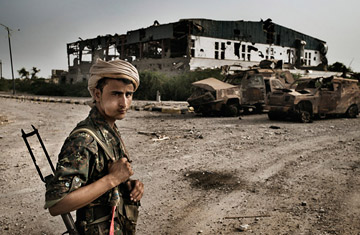
The fighting was fiercest in Zinjibar, where many of the jihadists chose to make their last stand. Their stolen tanks were easily eliminated from the air, but it took a heavy artillery barrage followed by bloody street-by-street battles to drive them out. As a result, this once bustling town of 20,000 is now in ruins. The retreating jihadists planted booby traps in the wreckage, which means clearing the debris will likely take months; civilians as well as military patrols continue to be killed by land mines. My colleague Yuri Kozyrev, a veteran war photographer, says Zinjibar reminds him of Grozny, the bombed-out capital of Chechnya, after Russian troops flattened it in the mid-1990s.
The Yemeni military is reluctant to disclose how many soldiers it lost in the campaign, although unofficial estimates run as high as 1,000. AQAP's losses were substantial as well: Major General Nasser al-Taheri, the new commander of Yemen's southern forces, estimates at least 600 jihadists out of a force of 3,000 were killed, including many from the core leadership. The general says that in recent skirmishes, "we've noticed their fighters seem to be mostly untrained recruits," suggesting that experienced fighters have been killed. Brennan is more cautious in his assessment, saying "a number of important players were taken off the battlefield."