

"May Allah curse those who did this." "May the criminals be condemned to hellfire." "They are not Muslims." "We must avenge our martyrs." The visitors' log at the site of Yemen's deadliest terrorist attack screams out with expressions of rage and calls for revenge. Yemenis arrive daily at Saba'een Square in the capital of Sana'a, the spot where over 100 cadets from the country's Central Security Force (CSF) were killed on May 21 when a suicide bomber from the group known as al-Qaeda in the Arabian Peninsula, or AQAP, blew himself up in the middle of a military parade. Posters bearing portraits of the dead, as well as of the over 300 who were injured, line enormous billboards erected at the scene. There are images, too, of the explosion's aftermath, photos of body parts strewn on the blood-spattered asphalt. A few meters away, visitors crowd into a geodesic tent to watch video of the explosion and TV footage of injured CSF cadets screaming and dying.
In most countries, the scene of a suicide bombing is quickly cleaned up, not least because a physical reminder of the attack could demoralize civilians while giving terrorists the propaganda victory they crave. The U.S. observes the 11th anniversary of 9/11 this week, but in the Middle East, commemorations of that nature are rare. The CSF, though, plans to replace the makeshift memorial in Saba'een Square with a permanent monument. Any concern that it could give AQAP free publicity is outweighed by the need to show Yemenis that the local franchise of Osama bin Laden's terrorist organization is a mortal threat not just to the West but to their country as well. Mahdi al-Jarbani, the drill major who trained the brigade singled out by the bomber, says the display is a wake-up call for his countrymen. "This is not something to hide away in shame," says al-Jarbani, who was standing just meters from his cadets and suffered shrapnel wounds from the explosion. "Let people recognize our enemy."
Yemenis have been slow to recognize the enemy in their midst. On my previous visit, in the fall of 2010, it seemed much of the country was in a state of denial about AQAP. Many Yemenis I met claimed the group was a figment of the paranoid American imagination. Others allowed that AQAP existed but insisted it was dangerous only to the U.S., not to Yemen, a Muslim nation of 25 million.
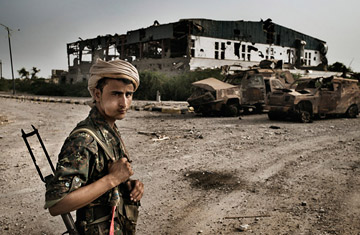
Over the past year, that delusion has been dashed. First, the terrorist group took control of towns and villages in the southern province of Abyan, holding on to them until driven off early this summer after a major offensive by the Yemeni armed forces. Then came a pair of deadly bomb blasts in the capital. On July 11, just seven weeks after the carnage on Saba'een Square, nine people were killed in an explosion outside the police academy. During my visit in July, I heard no talk of about make-believe terrorists, no sniggering about U.S. credulity. "Now it's become a national issue, no longer some kind of conspiracy," says political analyst Abdul Ghani al-Iryani. "There's a national consensus building against al-Qaeda."