

(2 of 8)
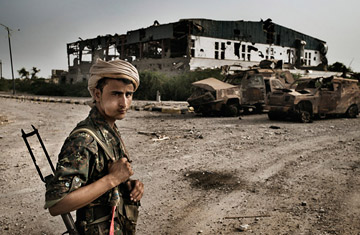
The turnabout in Yemeni popular opinion comes at a welcome moment for the Obama Administration, which has ramped up its own clandestine offensive against AQAP. Missile strikes from CIA and military Predator and Reaper drones have increased this year: according to the Long War Journal, a website that tabulates such strikes, there have been more than 29 since January, compared with 10 in all of 2011 and just four the previous year. A small contingent of U.S. special-operations troops is on the ground in the country, and, along with the CIA and regular U.S. military, it played a crucial, if officially unacknowledged, role in the Yemeni operation that reclaimed territory from AQAP in Abyan. U.S. aid to Yemen, one of the world's poorest nations, is expected to top $215 million this year, nearly double the sum in 2011. Counterterrorism and military aid will top $100 million.
The intensified focus on Yemen is an acknowledgment by the Obama Administration that AQAP may be the last remaining terrorist group that clings to bin Laden's dream of striking on U.S. soil. This makes it perhaps more dangerous than the greatly depleted al-Qaeda Prime, as counterterrorism experts call bin Laden's original group. In May, FBI director Robert Mueller told a congressional hearing that AQAP represented the "top [terrorist] threat to the nation." But the most telling indicator of the White House's concern about the Yemeni threat is that John Brennan, President Barack Obama's top counterterrorism adviser, has traveled there more than to any other country--so frequently that Yemenis joke that he should be granted citizenship.
With Yemenis now acknowledging the AQAP threat to their own country, there is hope for the first time that the group's threat to the West can be extinguished; it might be possible to remove it as a thorn in Yemen's side. But delivering the knockout blow will require political resolve, smart counterterrorism strategy and, most difficult of all, helping an impoverished, badly governed nation to its feet. Sound familiar? The fight against AQAP is poised where the war on bin Laden's own al-Qaeda stood at the end of 2001: the enemy has been soundly defeated on the battlefield and scattered. Now, as we learned in Afghanistan, comes the hard part.
The Holdover Holy Warriors
Bin Laden's vision of a "global jihad," in which militant Muslims would rise against the West, had faded long before his death at the hands of SEAL Team 6. His group and the many copycats it inspired across the Islamic world now tend to focus on local issues, usually confined to one country like Afghanistan, Pakistan, Mali or Nigeria. At most, some will occasionally foray across their borders: al-Qaeda in Mesopotamia mainly bombs Iraqi civilians or government targets but has recently exported fighters to Syria; al-Qaeda in the Islamic Maghreb confines itself to southern Algeria and northern Mali. Although these groups still threaten the West in rhetoric and pay lip service to bin Laden's vision of global jihad, they have shown neither the appetite nor the ability to mount a major attack on the U.S. mainland or in Europe.