

(3 of 12)
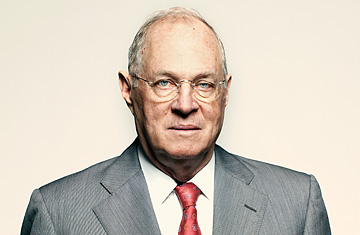
Efforts to fit Kennedy's major opinions into a clear, coherent philosophy have met with little success. He generally sides with the court's conservatives but is not tethered to any particular constitutional doctrine. "There is no grand unified theory for Justice Kennedy's jurisprudence," says Viet Dinh, a leading conservative court watcher whose law partner Paul Clement argued the case against Obamacare. Liberals are relieved there's one Republican nominee on the court whom they can reach with their arguments. "It is important to have someone who approaches each case with an open mind and who agonizes about trying to make the right decision, instead of trying to fit the case into some formulaic box," says Neal Katyal, Obama's former Solicitor General. Kennedy is often compared to his former partner in the middle, retired Justice Sandra Day O'Connor. But whereas O'Connor carefully crafted narrow rulings for individual cases, leaving tomorrow's decisions for tomorrow, Kennedy has a fondness for grand and sweeping statements--like this one from his controversial ruling in the Citizens United campaign-finance case: "independent expenditures, including those made by corporations, do not give rise to corruption or the appearance of corruption." Never? With this broad generalization, which seemed to go beyond the specific question of free speech at the heart of the case to bless every variety of so-called independent expenditure--including those not yet dreamed up by Washington pols--Kennedy opened the door to the very super PACs that now seem hell-bent on proving him wrong.
This uneasy combination of pomp and pragmatism may not add up to a clear philosophy, but it is the product of a particular place and time. According to those who know him best, Kennedy represents the epitome of "a Sacramento person," in the words of his friend Joan Didion, a writer and frequent visitor to the Kennedy home when she was a girl. (The future Justice was the kid brother of her close friend Nancy.) The small-town capital of a state as limitless as all imagination, Kennedy's Sacramento was "a very reasonable place" with "reasonable values," she says. It was "a system that worked," in the words of journalist Lou Cannon, a California political insider who knew Kennedy's father. In the decades after World War II, the seat of California government was a basically nonpartisan community, dedicated to "problem solving" rather than finger pointing, Cannon says. The ad hoc approach to issues favored individual power brokers who could find the middle ground. The more it fades into history, the more it is remembered nostalgically as a can-do culture nestled in a Norman Rockwell frame, a place where everything seemed possible, at least to those in power, and nothing seemed to change. "I don't think he's ever wanted to leave Sacramento in any real way," says Didion. "He wants that world in Sacramento whether it exists anymore or not."
Apprentice in the House of Warren