

(11 of 12)
Defenders of the health care law, on the other hand, appealed to Kennedy by quoting another statement from the same opinion: "Congress can regulate in the commercial sphere on the assumption that we have a single market and a unified purpose to build a stable national economy." They also noted that as recently as 2005, he joined an opinion by former Justice John Paul Stevens that upheld very broad federal authority to regulate individual conduct under the Constitution's commerce clause. That case, Gonzales v. Raich, dealt with the government's prosecution of a California woman who grew her own marijuana and used it as a medicine in compliance with state law. Angel Raich did not purchase the dope, nor did she sell it, nor did she or the marijuana ever leave California. Nevertheless, Kennedy agreed that the prosecution was a valid exercise of federal power over interstate commerce. A power as broad as that would surely allow Congress to require the purchase of health insurance, the pro-Obamacare lawyers argued.
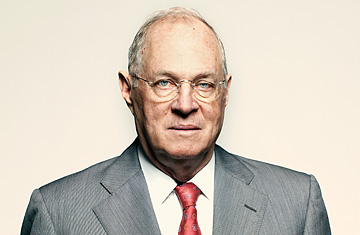
How will Kennedy come down on this one? It's possible that even his fellow Justices have no idea. Direct contact among the Justices is surprisingly limited. They prefer to communicate primarily by handwritten notes and e-mail. Most of their interaction comes during their highly secretive weekly conference, when they express their initial positions on recently argued cases and begin the process of drafting opinions. "People may imagine the Justices having lengthy debates about the outcome," says former Kennedy clerk Bradford Berenson, but such exchanges are rare. The opinions expressed at conference don't often change, but Kennedy changes his mind more than most. In one famous incident, Scalia went for a walk with Kennedy before the Casey abortion case was decided and came away from their heart-to-heart discussion confident that they would vote together. The next day, Kennedy went the other way.
An Uncertain Justice
As consequential as the health care decision will be, the role of Kennedy on the Supreme Court raises an even larger question. Is there something wrong in a democracy when one person holds so much sway over so many people? As year follows year and Kennedy remains the one key vote, his power compounds. More and more cases are decided based on his idiosyncratic values, and those holdings become precedents that future courts must respectfully contend with.
But Kennedy is not the only person responsible for this state of affairs. He would not have his majority-making power if his eight colleagues were not so rigid in their views. And the eight would not be so adamant if the political parties had not decided over the past generation that only carefully groomed, philosophically pure ideologues should be placed on the high court. Like the rest of the government, the Supreme Court has become polarized, increasingly unable to rise to the American tradition of splitting the difference, finding a compromise, muddling through.