

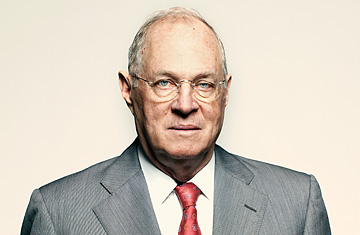
At 6 a.m. in the Northern Virginia suburbs of Washington, when some Pentagon brass and White House aides are just rolling out of bed, Justice Anthony Kennedy is dressed in a well-cut suit and rolling down the driveway of his modest home. He is cautious at the wheel. Even when the streets and highways are empty, Kennedy obeys traffic laws. "He would never cross the street against a red light," says a former colleague. He arrives 30 minutes later at the imposing marble temple across the street from the Capitol. Designed to appear as ancient as democracy itself even though it was built in the 1930s, the Supreme Court building is a good fit for the deliberately old-fashioned Kennedy: he is a pragmatist from postwar America set down in the middle of a polarized age. A man sometimes maddening, sometimes self-important, other times subtle, always thoughtful. A relic of a time when open-mindedness was seen as a virtue in a judge--or anyone else, for that matter.
Kennedy's chambers reflect his fastidious and formal character. The walls are painted to complement works of art on loan from various Washington museums. His desk is free of paper. Books line the walls. Here and there are nostalgic reminders of his home, Sacramento, including a miniature casting of the statue of a Pony Express rider that sits in the heart of the old gold-rush city.
So much order and consistency. In his routine arrival at his pin-perfect office, there is little hint of the internal struggles that have marked Tony Kennedy's quarter-century on the nation's highest court, struggles that have left an outsize mark on American life and liberty. Over that time, Kennedy cast the pivotal vote in cases dealing with abortion, the death penalty, gay rights, the war on terrorism, campaign finance and school prayer. This tall, thin man with clear blue eyes behind rimless bifocals is the decisive figure on a court that is otherwise divided between liberals and conservatives.
Beside a massive window overlooking the Capitol sits the small wooden table where Kennedy convenes his clerks to help him weigh his judgments. At that table, Kennedy has urged them to talk about what grounds he might cite to uphold Roe v. Wade. And what path would he take to strike it down? How would he justify allowing prayer at a public-school graduation ceremony? And what would be the strongest reasons for banning it? Does the Constitution protect the rights of homosexuals to engage in consensual sodomy in the privacy of their homes? And if it does, could a state get around that by outlawing sodomy among heterosexuals as well as homosexuals? The talk around the table can go on for hours--and even then, Kennedy sometimes concludes that he can't know if a decision is correct until he starts writing his opinion and sees what shape it takes.
Late in the afternoon, Kennedy usually leaves his chambers in time to beat the nightmarish Washington traffic, but he takes the struggle home with him and peppers the clerks with questions via his fax machine. After dinner with his wife, his hometown sweetheart from Sacramento's leafy and well-ordered Land Park neighborhood, the Justice returns to his briefs and precedents until 9 p.m., when he turns to nonlegal reading before bedtime. Next morning, he is back at his desk, giving scarcely any sign that he is closer to a decision.