

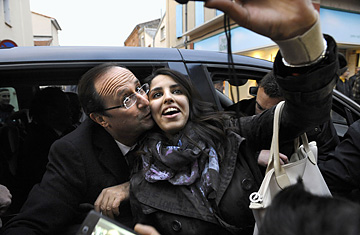
Francois Hollande, left, poses for a photograph with a fan during a public meeting at Place Jean Jaures
(4 of 5)
Europe will find out soon how Hollande and Merkel get along — the new French President is set to visit Berlin shortly after his inauguration — though the fact that mostly British newspapers have already begun to refer to their partnership as "Merde" does not bode well. Still, the rumblings of discontent with German austerity are only going to grow louder as Europe's economic outlook grows bleaker. Even Italian Prime Minister Mario Monti, who was not elected but appointed by Parliament, said the outcome of the French vote was a "call for a reflection on European policies." And if the European elite think the French are angry, wait until they hear from the Greeks.
Protest Vote
There are times when an election is less about forming a government than it is about registering a barely coherent cry of rage. That's what happened in Greece on May 6, when voters who had grown increasingly angry over the straitjacket fiscal policies forced on them by the European bailout had the chance to make that unhappiness known at the ballot box. By the time the smoke cleared, PASOK and New Democracy, the two parties that have dominated Greek politics for nearly 40 years, had received a combined 32% of the vote — less than half of what they had garnered during the previous elections, in 2009. Angry voters even gave 7% of the vote and 21 seats in Parliament to the neo-fascist Golden Dawn party, which is fond of using Nazi symbols and salutes. No party or coalition had enough support to form a government. "What the electorate wanted to do was punish," says Kevin Featherstone, a professor of contemporary Greek studies at the London School of Economics.
Given the amount of punishment the Greek people have endured over the past few years — made worse by the austerity measures pushed through to satisfy euro-zone demands — you can't really blame them. Unemployment has spiked to a record 21%, more than 100,000 small businesses have closed since the beginning of the crisis, and wages and pensions have been slashed. Gangs of hooded protesters take to the streets of Athens during demonstrations to vent their anger, attacking banks and clashing with tear-gas-throwing riot police. Homelessness is on the rise, and the government says the number of suicides has jumped by at least 40% in the past two years. "This has got to end before the country completely collapses," says Aris Papadopoulos, 36, a computer scientist who lives in Athens. "Everyone is going to leave for jobs abroad because there won't be anything left for Greece."
Papadopoulos voted for Syriza, a coalition of radical left and green groups led by Tsipras, a young engineer known for shouting down pro-bailout politicians in Parliament. About half of Greeks voted for anti-bailout parties. Whoever forms a governing coalition, it's clear that the Greek elections will have ramifications beyond Athens. "We want to send a message to Europe from the country where austerity policies started," Rena Dourou, a parliamentary deputy for Syriza, told TIME after the elections. "We want to stay in the euro zone so we can change the euro zone's policies, because those policies are unfair to people. But we won't stay if Europe gives us no choice but austerity."