

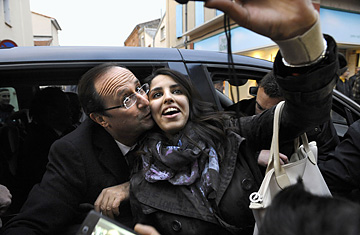
Francois Hollande, left, poses for a photograph with a fan during a public meeting at Place Jean Jaures
(2 of 5)
Though another round of elections may be required to get one, a campaign promise by Tsipras has had broad resonance — to cancel the bailout-loan agreement that imposed severe economic pain on Greece, an act that would almost certainly intensify the European debt crisis and could even lead to a full-scale Greek default and exit from the euro. That in turn could further destabilize the increasingly fragile European monetary union and worsen recessions in much larger countries like Italy and Spain. For now, Germany is standing firm, but the pressure to relent is growing on Merkel, as it will on the new President of France, who has promised a kinder, gentler response to Europe's troubles. "It can't all be sacrifice. Effort must be made to nurture, and with it hope," Hollande told TIME in a recent interview. But if there's anything that's become clear, it's that Europeans aren't hopeful. They're angry, and it's not clear that Europe's political elite can cool that anger.
Flanby to the Rescue
The French presidency is one of the most powerful political positions in Europe, which makes Hollande's background all the more unusual. Before he stepped down as head of France's Socialist Party in 2008, Hollande's highest-profile national positions were as a junior adviser to then President François Mitterrand in the 1980s and a member of Parliament for several terms. The mother of his four children, former Socialist Party head Ségolène Royal — who lost to Sarkozy in the 2007 presidential elections — had long been better known than the colorless Hollande. (He and Royal separated in 2007, and since then Hollande has been with Valérie Trierweiler, a journalist for Paris Match.) Though he has the first-class educational training of France's bureaucratic elite, his résumé compares poorly with that of Sarkozy, who came to national attention as France's youngest mayor in 1983 and served numerous terms as a government minister before becoming President in 2007. Averse to confrontation, Hollande has been nicknamed Flanby, after the wobbly caramel custard, including by some members of his own party. "He doesn't have the stature to be President," sniffed former First Lady Bernadette Chirac in March as she pressed the bid of Sarkozy (who headed the Interior Ministry, among other portfolios, for her husband Jacques). "Being President requires a lot of experience, long political training."
But after five years of Sarkozy's brash, even vulgar style, Hollande's genial dullness came as a relief to many in France. While somewhat stiff in formal settings, Hollande can be engaging and amiable in person and is known for zipping around on his scooter, which he'll likely have to give up riding now. Compare that with the bling-bling presidency of Sarkozy, who famously vacationed after his 2007 win on the yacht of a billionaire friend in the Mediterranean. "François dislikes brutality, avoids imposing his will on people and much prefers motivating people into doing what he wants them to do," says Bernard Poignant, the Socialist mayor of the city of Quimper and a close friend of Hollande's. "He usually gets what he wants, which we've now once again seen."