

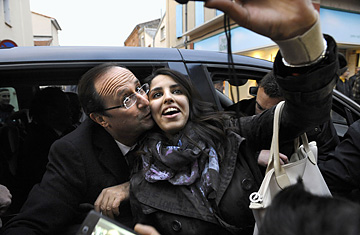
Francois Hollande, left, poses for a photograph with a fan during a public meeting at Place Jean Jaures
There are surely people who are ecstatic that François Hollande, 57, will be the new President of France — perhaps the members of his immediate family or the residents of the central French city of Tulle, where he spent seven years as mayor, who gave him more than 75% of their votes. But the mild-mannered Hollande, who narrowly beat incumbent Nicolas Sarkozy in a runoff election on May 6, became the first Socialist to lead the French Republic since 1995 as much for what he isn't as for what he is. He isn't Sarkozy, the temperamental conservative with the supermodel wife and ostentatious taste for wealth who polarized France during his five years in the Elysée Palace. He isn't Marine Le Pen, the far-right firebrand with xenophobic views on Islam and immigration who won nearly one-fifth of the votes cast in the first round of the presidential elections. Hollande, who assumes office with no experience in national government, won control of the world's fifth largest economy by promising to be a "Président normal."
But these are not normal times. Hollande was also propelled into power on a wave of public unhappiness with the fiscal-austerity policies driven by Sarkozy and German Chancellor Angela Merkel. It wasn't just Sarkozy whom France was rejecting; it was Merkozy, the tight partnership between the two leaders who have led a take-no-prisoners budget-slashing crusade to save the European monetary union — a strategy that is now being questioned in both political and economic circles. "In all the capitals, beyond government leaders and state leaders, there are people who, thanks to us, are hoping, are looking to us and want to put an end to austerity," Hollande told a cheering crowd in Paris after the election. "Europe is watching us. Austerity can no longer be the only option."
France isn't the only country having second thoughts about the austerity ideology that has dominated European fiscal policy since the Greek debt crisis began in 2009. In Britain, Prime Minister David Cameron's Conservative Party suffered heavy losses in local elections as voters rebelled against spending and welfare cuts. In Italy, voter discontent with fiscal austerity is bubbling up with rising support for protest parties, including one headed by a comedian who wants to see the country default on its debt. And on the same day as the French election, voters in Greece overwhelmingly repudiated European austerity policies and the lawmakers forced to implement them. Greeks punished their ruling parties in parliamentary elections, turning to an array of anti-bailout parties on the far right and far left and leaving Greek politics in disarray. "European leaders and especially Merkel have to understand that austerity policies have suffered defeat," said leftist leader Alexis Tsipras, whose young party came in a surprising second and was given an opportunity to form a government.