

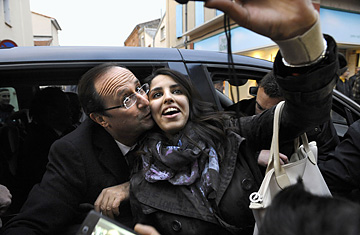
Francois Hollande, left, poses for a photograph with a fan during a public meeting at Place Jean Jaures
(3 of 5)
Even so, Hollande had to struggle to connect with a deeply dissatisfied French public. Two extreme candidates — Le Pen and the hard-left Jean-Luc Mélenchon — earned more votes combined than Hollande in the first round of the elections. In the end, Hollande was able to edge past Sarkozy in the second round by tapping into French anger about finance and wealth that had only grown as the debt crisis worsened. In 2006, Hollande admitted, "I don't like the rich," and in January he declared that "my real enemy is the world of finance" and promised to raise income taxes on the affluent — including a 75% rate for those earning more than $1.3 million annually. (The current rate is 41%.) He pledged to create 150,000 state-subsidized jobs for youth to battle an unemployment rate nearing 10% and to roll back Sarkozy's major achievement, reform of the swamped pension system, by returning the retirement age for some workers to 60 from 62. It was a platform made for France's 99%. "There need to be signs of fairness and of equal treatment across society," Hollande told TIME on a campaign outing.
Still, while his campaign slogan was "Change now," that change may have been more about rhetoric than actual policy, especially when it comes to dealing with Europe's toxic debt crisis. He has been a vocal opponent of the Sarkozy-Merkel austerity-only policies designed to save the European monetary union, but supporters note that Hollande advised mentor Mitterrand ahead of the euro's conception in the 1990s and has no desire to kill the currency. For all his leftist talk on the campaign trail, Hollande is center-leaning and has acknowledged the need to reduce France's huge $2.2 trillion public debt. While the German Chancellor will surely miss Sarkozy — she made the unusual move of publicly supporting her counterpart's re-election bid — supporters say she may find Hollande more cooperative than she expects. "They'll get on fine," predicts Alain Duhamel, a French political analyst.
But that assumes that Merkel will take Sarkozy's loss and the simultaneous revolts in Greece as evidence that Germany needs to compromise on austerity. There's no indication yet that Berlin is softening, though it's clear austerity without growth stimulus can't keep the troubled euro viable. Hollande has proposed a range of pro-growth policies, including the creation of a public investment bank and tax breaks for small business, incentives for companies to retain workers and deployment of E.U. financial institutions to ease the euro crisis and underwrite E.U. infrastructure projects.
Still, investors who are jittery about rising government debt will watch to see if the new President weakens rather than strengthens the nation's finances in an attempt to stimulate growth. While Hollande has called for a renegotiation of the compact on debt reduction that European leaders adopted in March to add growth capacities, Merkel considers the matter closed. At a news conference on May 7, she explained her rationale for holding the line on spending, arguing that the debt crisis was a consequence of coordinated stimulus spending in the first phase of the European financial crisis. "We are in the middle of a debate to which France, of course, under its new President, will bring its own emphasis," she said. "But we are talking about two sides of the same coin. Progress is achievable only via solid finances plus growth."